
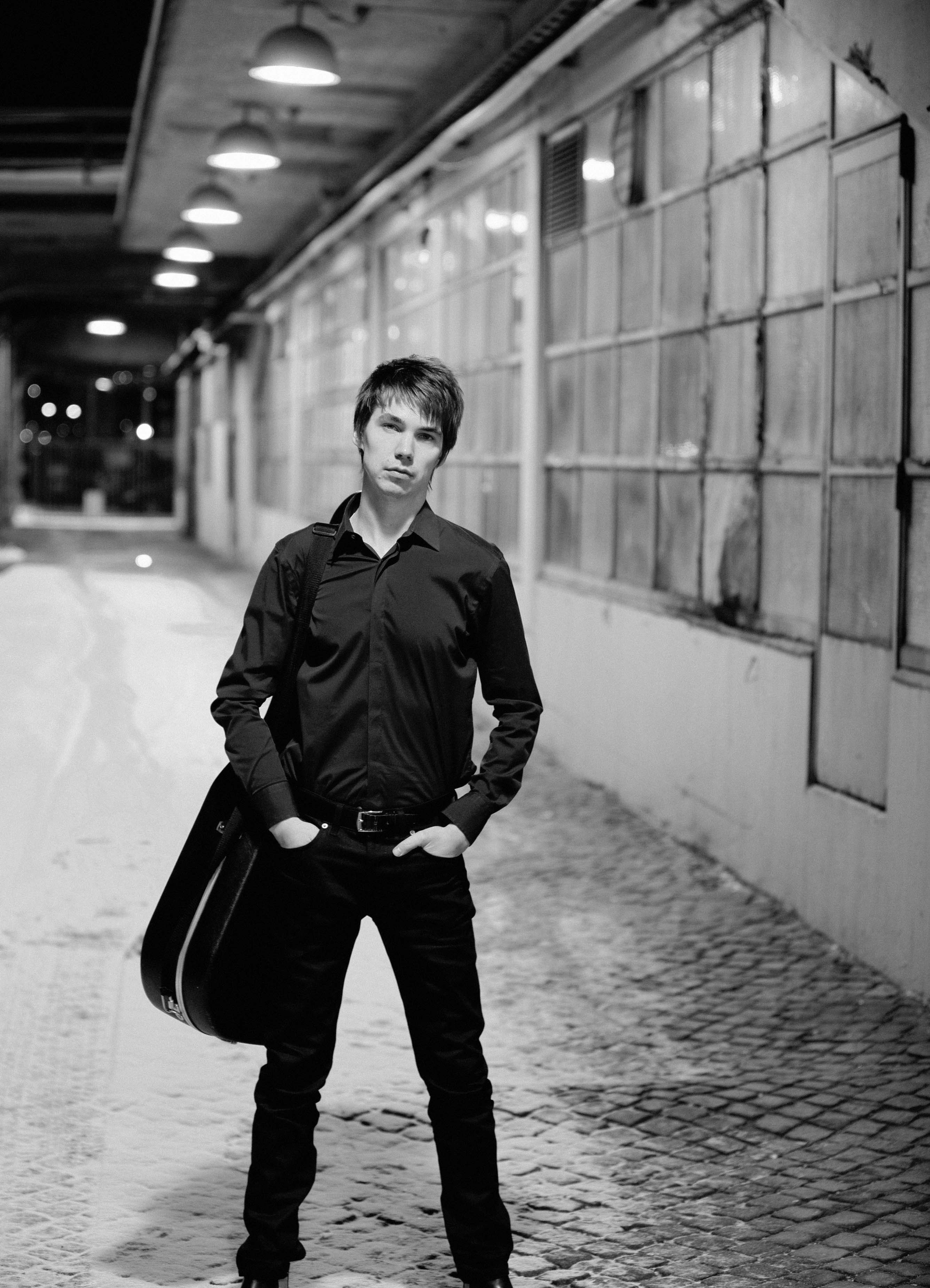
I’ve previously mentioned the up-and-coming young Melbourne-based guitarist Daniel Nistico on this blog. He really is a guitarist to watch out for in the next year or two. I’ve seen him develop as a guitarist and musician over the last 18 months or so (and have even had the pleasure of playing alongside him in a Slava Grigoryan Masterclass and most recently with the CGSV Guitar Orchestra) – he truly is player of fantastic talent and musicality, not to mention being a thoroughly decent kind of chap, incredibly modest, oh and has awesome hair too.
Daniel frequently performs around Melbourne, including the Classical Guitar Society of Victoria‘s Twilight Recitals, and is a very active member of the Society too. He features regularly on both 3MBS Fine Music and ABC Classic FM. Last year Daniel represented Australia and New Zealand, winning the 2011 Lions Global Youth Music Competition, really establishing himself as a concert guitarist of high calibre.

So, I thought I’d take the opportunity of introducing you, dear readers – particularly those of you outside Australia – to one of Australia’s hottest rising stars. Remember you saw him here first!!
Daniel took some time out of his busy schedule between practice session, competing in the finals of the Adelaide International Guitar competition and hanging out with the glitterati of the classical guitar world to put pen to paper (or rather fingers to keyboard) to tell us a bit about himself.
What’s your background with the guitar? How did you get started?
My dad played some tapes of John Williams and Karin Schaupp (yes, cassette tapes!) in the car when I was young and I really enjoyed listening to them. Also during this time my dad played classical guitar as a hobby, having previously been in a band. When I was around 12 I asked my dad to teach me what he was playing and so he did.
The first pieces I learned were mainly Italian and Spanish popular song arrangements like Granada, Besame Mucho and Spanish Romance. Due to the fact that my dad taught me frequently (almost every night) and by imitation I learned these pieces in a short period of time. Eventually I was instructed to read music by myself. I then spent hours each day figuring out how to read music on the guitar. Not too long after this I studied with Susan Ellis and then attended ANAM young academy and VCASS where I studied with Ben Dix.
How was your preparation for the Adelaide International Guitar Festival?
Well preparation for concerts is always a bit daunting, especially for something like a competition or exam where the panel are listening very critically.
I chose pieces that I’ve known for quite some time so it’s mainly been about refining the interpretative elements and keeping the difficult passages under control technically. I’ve been recording myself a lot and I find that very useful because it often reveals how distorted the balance of your ideas can be sometimes – they’re either not happening or being overdone!
What else are you working on at the moment and what can we expect to see from Dan Nistico in the next year or so?
I’m working on some repertoire for the end of year exam at uni (Daniel is currently studying for a Masters degree in Music Performance at the Melbourne Conservatorium of Music). This includes Prelude Fugue and Allegro by Bach, Sonatina in A by Torroba and a much more recently composed piece by American composer John Anthony Lennon, also called Sonatina.
I’m also preparing for my debut album that will be recorded in December. The repertoire for this will include Invocation et Danse by Rodrigo, Mazurka Appasionatta by Barrios and the previously mentioned Sonatina by Lennon.
By mid next year I will have completed my Masters degree if all goes to plan. Once the CD that I’ll be recording is released I’d like to do an Australia-wide tour to promote it.
I’m also currently applying for a scholarship to study a Doctor of Musical Arts in the United States at either Yale or Eastman School of Music. I would also like to travel and attend guitar/music festivals overseas and participate in more competitions – they’re a great way of gaining some exposure amongst great artists and guitarists.
What music excites you the most and why?
The answer to this question probably changes from time to time. In terms of playing and performing, the music of Bach is probably one of the most exciting for me because there is always such depth in structure, technique and expression. I find Bach to be very challenging at times because sometimes the structural complexity can hinder my ability to interpret the piece in a manner that will be moving for myself and listeners. But this is why it is exciting for me!
What are your top tips for someone learning or thinking of learning the classical guitar?
The first tip I can give is to get absorbed in the culture of the guitar, which is quite easy to do these days with the help of technology. Find pieces and guitarists that you enjoy listening to. Go to live concerts. Develop a passion for the music and the instrument if you don’t have it already.
Find a suitable teacher. For a beginner this might be different than for a more experienced guitarist. Again there are many resources online for finding teachers.
Look for a decent instrument, as it can be a hindering for your development if your guitar is not working for you.
Try and find other beginners who have similar interests to you and play at a similar level. A good way of doing this in Melbourne is to attend the guitar gatherings and play in the Guitar Orchestra. That would probably establish a good starting point and from there it is up to the person to follow through and see where it takes them – it’s well worth the journey. Imagination and discipline are two ingredients that I think can create a good recipe for a musician.
The Aussie classical guitar scene, I think you’d agree, is definitely growing and becoming stronger. Where do you see it headed in the next couple years?
Yes I definitely agree with you there. There are many strong guitarists and guitar ensembles emerging in Australia. I think this is largely due to the increasing numbers of quality guitar teachers in Australia including my own, Anthony Field and his teacher Tim Kain.
The incredible number of quality guitar luthiers is playing a part as they have helped define the “Aussie sound”. It also seems to me that the international guitar scene in general is flourishing. There are more festivals, competitions, masterclasses and concerts and I think Australia is starting to be part of this culture. The Adelaide Guitar Festival is a good reflection of this.
Which players do you find the most inspiring or exciting?
This can change somewhat from time to time, but there are a few that I’ve recently found inspiring. Jorge Caballero, Rafael Aguirre, Marcin Dylla, Zoran Dukic and Ricardo Gallen are to name but a few. If you haven’t heard of them then I recommend going on YouTube right now!
When you’re not practicing and playing, what do you get up to? Activities with minimal nail damaging potentially presumably?!
Yes, nail damage can be an influence on the hobbies us guitarists take up. I enjoy reading, Yoga, video games and drinking good beer with friends. I find the balance of practice to be really important – sometimes staying inside and practicing all day can have negative impacts. It can also be beneficial to take a break from music related activities in order to refresh your mind.

How was the Adelaide International Guitar Festival experience for you?
It was a great festival this year! A spectacular line up of performances, including Ana Vidovic and Paolo Bellinati. It was a good vibe being surrounded by luthiers, students, professionals and guitar aficionados all in the one place – very inspiring. The schedule was jam packed and very hectic, especially when you have to fit in some time for practice! Basically you’d wake up, get ready, go to some classes or talks, watch a few concerts, hang out at the bar and go to bed!
You did fantastically well getting through to the final of the competition. What are your thoughts on the competition? How you played? How others played?
Thank you, it was nice to get through to the final round. I thought I played quite well in the semi-final round – it was a bit more casual and the room was small and not hard to fill with sound. In the finals I found the venue to be a little dry acoustically and coupled with the fact that it was such a big performance I think I might have pushed myself a little harder than usual, which can have quite negative affects on your playing.
I performed Prelude from Lute Suite 995 by Bach and La Catedral by Barrios. We had a 15 minute time limit with at least one work needing to be pre-1850 and another post-1850. The standard was incredible all round this year – I managed to watch the second half of the finals in which 3 out of the 4 performers got placed, including the winner Andrey Lebedev and big congrats to him!
What really stood out to me was the different styles of playing you observe when hearing players back to back – it’s great to see such individual style even when the same pieces are being performed. Not to mention all the different guitars used, from traditional to Smallman. Even appearances were quite varied and unique.
Which acts did you check out at the Festival and which was your favourite?
I went to almost every concert! There was Slava and Leonard Grigoryan and they did an arrangement of The Seasons by Tchaikovsky – that was absolutely stunning playing, they even swapped guitars for one of the movements.
Ana Vidovic played a solo concert and she is certainly an incredibly refined performer. Her sensitive phrasing, dynamics and command of the instrument really stood out to me. I was a little disappointed with the repertoire, but I can understand that it’s her first Australian appearance so it’s probably a safer option to stick with the “classics”.
Paolo Bellinati and another guitarist Weber Lopes performed some groovy Brazilian original compositions, including Bellinati’s big hit Jongo. This concert just kept getting better and better, some really rhythmic and expressive playing happening.
The little I saw of jazz legend John Scofield was utterly incredible – unfortunately I had to do a sound check for the competition at the same time as his concert. Scofield has an incredible musical language and sound palette, coupled with an extreme mastery of the instrument. There seemed to be no boundaries in what he was doing.
Edin Karamazov was one of the most unique players I’ve ever seen. He played lute and guitar and fairly standard repertoire including Bach’s Chaconne, 3 Barrios Valses and Invierno Porteno by Piazzolla. Eden sounded as if he hadn’t touched a guitar for a few weeks, but somehow he managed to enrapture the audience with his charismatic and eccentric playing style, taking liberties at every corner of every bar of the pieces he played (and even not adhering to his program, playing pieces that weren’t on there and not playing pieces that were!).
I think his performance caused a little controversy as some people would be utterly gobsmacked at how much liberty Edin was taking. Nonetheless I enjoyed his concert simply for the fact that it was so different to what you normally here, quite refreshing.
Guitar Trek played a marvellous concert, including some big Australian works. Phillip Houghton’s News From Nowhere (a work that I’vve performed) was the highlight for me. It’s a work that uses the guitar family, which includes a bass, baritone, standard and treble guitar, creating a big scope for extending the range of the ensemble. This work also uses some cool effects including banging a tuning fork on your knee and resonating it on the guitar and swiping a New Zealand $2 coin on the strings (it has frayed edges and makes a particularly scratchy effect).
What got my attention with Guitar Trek was there incredibly rich and beautiful sound and great ensemble communication.
The Australian String Quartet played some quintets with four guitarists – Slava, Ana, Simon Powis and Edin. They performed quintets by Tedesco, Houghton, Boccherini and Beatles arrangements by Brouwer. Stunning concert and repertoire; it was so good to hear a quality string quartet amongst all this guitar playing!
The final concert that ended the festival Caminos Flamencos from the US. The guitarist Jason McGuire was phenomenal (I’m running out of adjectives now) his electrifying playing was coupled with incredible dancing and singing – it was a bit of a fusion between jazz, contemporary and flamenco, but it worked very effectively. It’s too difficult to pick a favourite, so my apologies but I simply can’t!
Be sure to check out some of Daniel’s playing here:
And don’t forget to check out his own blog and website here, too: www.danielnistico.com
Related articles
- Get excited! It’s the Adelaide International Guitar Festival!! Woop! (classicalguitarnstuff.com)


 Classical Guitar n Stuff