
I had the enormous pleasure on Saturday night to experience what is probably one of the best classical guitar concerts I’ve been to. Yes, I know I’m always quite a positive person and ready to heap praise on the fabulous artists I have the pleasure of listening to and watching, but this concert 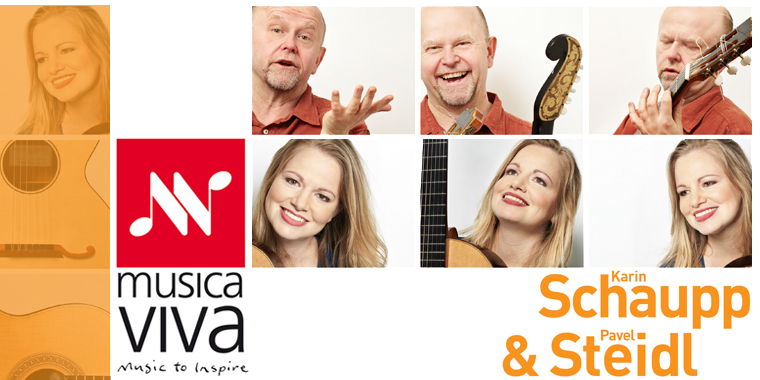 really was that good!
Karin and Pavel, both reasonably commanding presences on the stage in their own right, really drew the audience in with not just their playing (and I’ll get onto that in a minuet), but also with their conversation throughout the evening. They made the Elizabeth Murdoch Hall in Melbourne’s Recital Centre feel like a very intimate venue, with their inviting conversational style. This was a high art concert yes, but with a fantastically informal, informative and light-hearted approach. Take note other guitarists and chamber musicians!
The program (or programme depending on where you’re from!) was a tale of two halves. The first half of the program was presented entirely upon Romantic period guitars, including a Stauffer-stye Terz guitar built for Schaupp by Perth based luthier Simon Rovis-Hermann just last year, especially for this tour. Schaupp also played a standard size Romantic guitar by the same luthier, and Steidl a standard size Romantic guitar by Cologne-based luthier Bernhard Kresse.
Karin and Pavel opened up proceedings with a couple of delightful Merz duets (Am Grabe der Geleiben and Unruhe). This was followed up with Sor’s fantastically French flavoured L’Encouragement, not before the artists regaled us stories of the guitar’s progression in terms of its construction to this point as well as the history of the various composers and players of the time.
Pavel then took centre stage to play a couple of Paganini solo pieces (Minuetto che va chiamando Dida and Valtz). This style of music, and these pieces in particular, suit Steidl’s style to an absolute tee. He is a supreme technician of the instrument – a must when playing works as intricate (and perhaps uninviting on initial viewing) as those by Paganini. Much more than this, these works really give a stage to Steidl’s marvellous approach to the “fine” style of guitar playing (as he himself called it). That is to say really just taking what is written on the page as just the very basis from which to explore the music – the colours, the tones, the movement, flow and phrasing, different effects, cadenzas and a bit of ad libbing here and there. And this he did with much cheeky vivacity, exaggerated physical gestures, showmanship and Bream-on-methamphetimines face pulling! Sheer brilliance.
The first half was then rounded out by two movements from the aforementioned Bream’s duet arrangement of Schubert’s String Quartet No. 9 in G Minor (played by Bream and John Williams back in the early 1980s). This was just a delicious ending to the Romantic first half, with Karin really demonstrating her capacity for gorgeous tone production and lightning fast left and right hand dexterity.
The second half of the concert focussed on music from the twentieth century, starting out with two of Granados’ Spanish Dances (Orientale and Rondalla aragonesa). It was time then for Karin to take centre and play one of her favourite twentieth century solo pieces, Albeniz’s Torre Bermeja (ranscribed from original piano score by Miguel Llobet). This was an awesomely moving rendition of this well-known staple of the guitar repertoire – full of passion, power and control over some stunningly even and fluidly fast arpeggio passages – one of the best renditions of this I think I’ve heard, recorded or otherwise in fact. I know this show was about the duo, but this piece was the stand-out of the evening for me.
Karin and Pavel then treated us to a little self-made suite of three pieces, made up of two Australian pieces (Ross Edward’s Djanaba and Phillip Houghton’s Brolga) – a nod to Karin’s origins – with a piece from the Czech Republic (Janacek’s The Barn Owl Has Not Flown Away from On An Overgrown Path) – a nod to Pavel’s origin’s. And the fabulous evening was rounded out with a superb slice of Brazilian rhythm in duo form with Radames Gnattali’s Ciquinha Gonzaga (Corta Jaca) from Suite Retratos.
Ooh, actually that’s not quite right, there was a delicious encore of one of Mendelssohn’s Songs Without Words (my apologies, I can’t recall exactly which one!) from the duo to send us gently out into a balmy early autumn Melbourne evening (or downstairs into the Salon for a bit of a “meet and greet” question and answer session with Karin and Pavel anyway!).
A fantastic, fantastic concert, by arguably two of the greatest guitar performers currently touring. They have some dates still to perform in the next week or two across Sydney, Brisbane and Adelaide. I HIGHLY recommend you get yourselves along – it’s a truly inspirational concert not to be missed!
If you want to know a wee bit more about these two wonderful performers head over to my preview of the concert HERE.
Thank you Karin and Pavel for a wonderful concert and thank you Musica Viva for hosting two fabulous stars of the guitar! More! More!
Related articles
- Time to Get Excited! Karin Schaupp and Pavel Steidl on Tour in Oz! (classicalguitarnstuff.com)

 Classical Guitar n Stuff