I thought I’d go with a bit of a back to basics type post today to help some of the classical guitar newbies (or perhaps not so newbies!) out there. So today we’re going to look at (or listen to?) tone colour (or timbre as its also sometimes referred to).
Regular readers of this blog will often read the words “colour” or “tone colour” when I’ve been perhaps referring to playing a piece of music or describing how someone plays a piece.
What does it mean?
Well, obviously we can’t actually physically “colour” something as such when playing guitar as colour tends to be a visual thing right (unless you’re synaesthetic and your senses are intertwinned), but we can change the mood, the feel, the texture of the sounds we make when playing the guitar. It’s quite a fantastically versatile instrument in that respect.
Different instruments tend to have their own inherent tone colours (and this is all to do with physics of soundwaves – harmonics, sound envelopes and so on, but I won’t go into that here). The flute, for example, could be said to have quite a bright, shrill timbre or a bright, brash, bold tone colour (a bright yellow if you want to go down the line of the colour theme). The bassoon on the other hand could be said to have quite a warm, rounded, soft timbre (or a perhaps a purply-brown, deep rich colour).
Getting the idea?
So colour on the guitar?
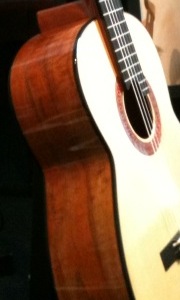
So, just as the instruments I gave as an example above the guitar too has its own inherent kind of tone. There’s a degree of subjectivity in any description of course, but one could argue that (playing in normal position over the soundhole) the guitar’s tone colour is somewhat bell-like, on the brighter side. An orangey-red perhaps?
Can we change the tone colour on the guitar?
Absolutely we can! We can get brighter, more zingy. We can also get richer, more velvety, more bassoony if you like.
How do we create those?
Well, it’s actually pretty simple. To get brighter player closer to the bridge. The closer to the bridge the brighter the sound. Then conversely, the further you play over the soundhole, towards and even over the fretboard the warmer and more “bassoony” the sound.
And here is where we might hear or see written on your sheet music some words that might describe or point you in the direction of creating a certain tone colour. We often use the word ponticello to direct us to playing towards the bridge and we often use the word tasto to indicate playing more towards or over the fingerboard. We may also interpret the word dolce (which is the Italian word for sweet) to mean tasto playing too.
Give it a whirl and check out all the different tone colours you can make.

 Classical Guitar n Stuff