Playing Legato on Classical Guitar

Legato – no not a kind of pasta, Italian composer or some kind of giant plastic building blocks.

Nope. For the initiated in Italian musical vocabulary (and for those that need a little reminder), it is the act of playing smoothly and connected with very little, if any at all, space between each of the notes you play. Think how a violin might play something, with its nice bowing action, able to make all the notes connected together. Not. A. Gap. Bet-ween. Each. Note. But-a-nice-fluid-phrase-notes-connected-to-one-another….

We have it a little more challenging on the guitar, as a plucked instrument, to get that nice connected, legato feel in our playing. It is certainly, by no means, impossible however. Like most things on the guitar it just needs a little awareness of what you’re currently doing, how you could change that up and do it differently and then practicing it!

Prepare your left hand

One of the key elements of playing nice and smoothly is getting your fretboard hand (left hand if you’re right handed, right hand if you’re left handed) prepared and ready, loaded up and ready to fire*.

What does that mean?

That essentially means putting fingers down before you need them. And I don’t mean just immediately, a nano-second fretting a note prior to playing it. To get that lovely, smooth, connected feel we need to pre-load fingers behind fingers – first, second or third fingers (depending on what you need) down behind a fourth finger, for example, before you need them.

Say what?

OK, it’s a bit difficult to explain this kind of thing via the written word sometimes,s o I have recorded a wee video snippet for you (how exciting!). In this little clip you’ll see me playing just a simple one octave descending C major scale – watch how I have prepared, or pre-loaded, my fingers well before I need them. My fingers also don’t come too far away from the fretboard either. Less distance to travel = less time to get them back to where they need to be = easier, smoother playing.

Get prepared, get slurring

Taking this approach is also going to make things WAY easier when you come to play slurs.

Same dealio. Get the fingers pre-loaded and ready. Don’t try to start a slur with the finger you’re sluring to up somewhere in the ether. Get it down on the fretboard and ready before you play the slur. It will create a much smoother sounding slur and it will likely produce a stronger sounding slur too as you have something that you can counter the string movement with as you pull off.

Here’s another little video of me demonstrating that for you:


See if you can find the opportunities in your music to “pre-load” the fingers

Admittedly we don’t always have the choice or the luxury of putting fingers down or leaving them down to be used again, but it’s probably a good idea to get into the habit of looking through your music and seeking out places where you can comfortably do that. It’s such a tiny little thing, a tiny little movement really, but it can make such a massive difference in how a piece of music sounds.

Get smooth!

*To play smoothly there is also certainly an element of ensuring that the right and left hand are well co-ordinated with one another (but that’s a subject for another time).

From Nylon to Steel and Back

Well, peeps we have our first guest post today from the very talented Rick Alexander (you may remember his name from a post back in September last year. If you want to recap head here). So, without further ado, over to Rick…..

From Nylon to Steel and Back  by Rick Alexander 

A few weeks ago Nicole posted about how to get back into classical guitar after a long break. That day I emailed her with an idea for a similar topic:  How about a post about  “how to change back and forth between playing steel string and nylon string guitar?”   So I was pleasantly surprised when Nicole suggested I write a post myself about this topic.  Thank you Nicole!

I wonder if there are a few of you out there like me. For almost 20 years now nylon string guitar has been my first love. But I’ve been fickle; there have also been long periods where I’ve mostly played steel string. When I came back to nylon string I used to find it took me quite a while to get used to it again. The guitar felt pretty unresponsive in my hands and my left hand fingers would sometimes miss the strings.  But lately I’ve felt better when changing guitars so I thought I’d share what I’ve been doing so that I can enjoy playing both types of guitar.

Some ideas:

Don’t play steel string, always play nylon string!  This would be nice, I agree, but there are good reasons to also play steel string guitar. There is fantastic fingerstyle steel string music to play (think Tommy Emmanuel). Steel string guitar has great sustain and that fantastic “zing” on the trebles, especially with new strings.  Another plus is the beautiful contrast in sound between steel string and nylon string guitars in a duet. So, given that we also want to play steel string guitar, what then?

Change back and forth between guitars frequently.   I’ve found it much better when I change guitar type more often. I start getting used to both guitars and I find that without me thinking too much my left hand fingers know where to go on both guitars.

Guitar hanger
Guitar hanger

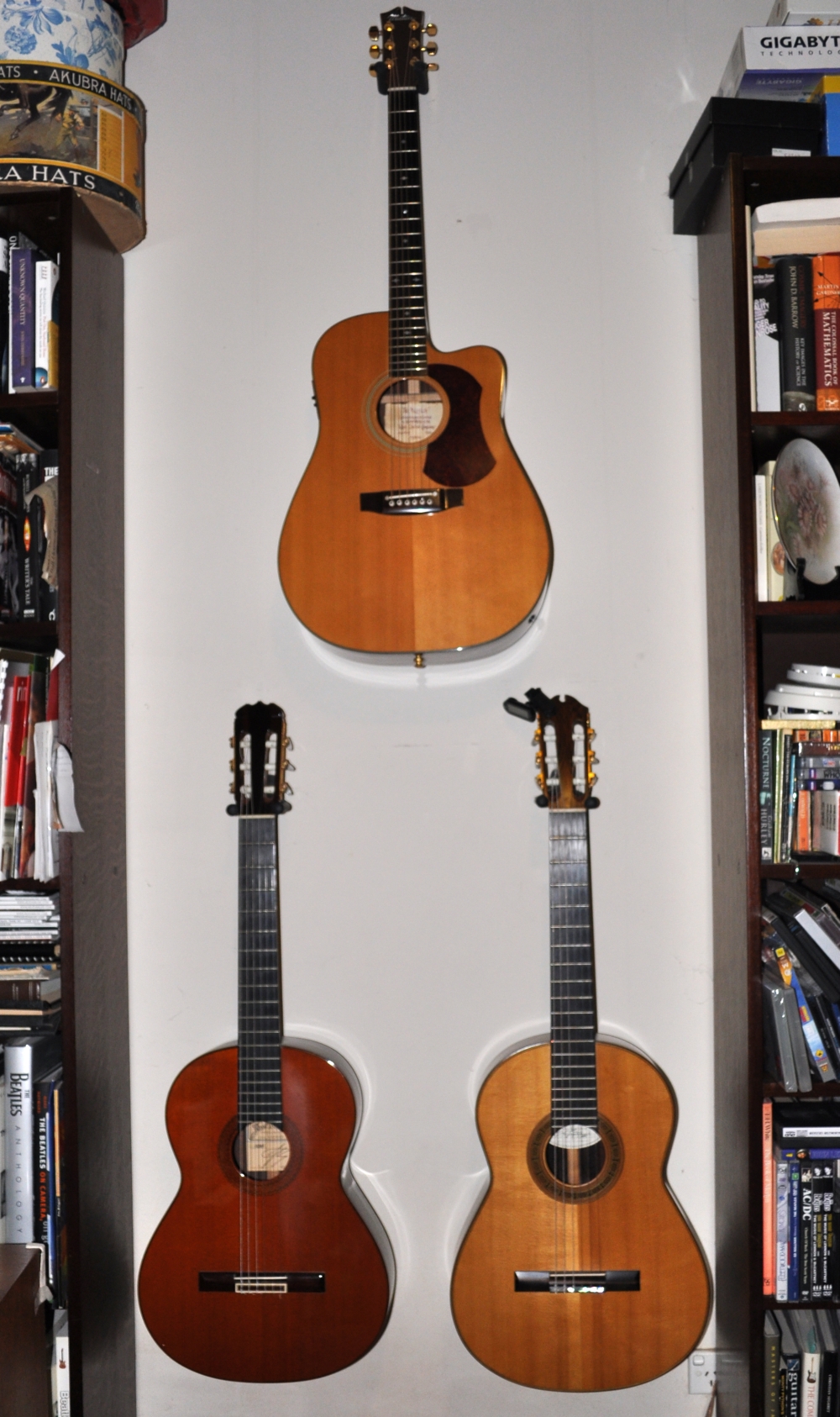
To help changing guitars I suggest investing in wall hangers for your guitars.  Hang your guitars on the wall so they’re easy to access.  A bonus is that it’s cool being able to see your guitars up there.

I used to keep my guitars in their cases and I found it’s too easy to leave one in its case for too long. When they’re on the wall they’re so much more accessible. They do get dusty but I can live with that. Your guitars are meant for playing.  They should be out and ready to go.

Please be careful to securely mount the hangers. (I mean really securely.) I have hollow plasterboard walls and used spring toggles. If you’re not sure of your DIY skills please get help!  Also – if you have dogs or small children around the house I’d hang the guitars out of their reach.

Have a steel string guitar with wider fingerboard.   My two classical guitars measure about 45 mm from E string to E string at the nut while my Maton steel string with a 1 and 11/16” wide fingerboard at the nut measures 37mm  E to E. (The finger board width at the nut for steel string guitars is often expressed in round

Hang your guitars on the wall for easier access

numbers in inches. 1 and 11/16” is standard and 1 and 3/4” is a wider finger board.)   Maton and other manufacturers such as Taylor also make steel string guitars intended for fingerstyle playing and these guitars have the wider 1 and 3/4” fingerboards.  For example, my Taylor has a string pitch of 39mm  E to E. I find that the extra 2mm is noticeable. Using one of these wider necked steel string guitars makes it a bit easier to change from steel to nylon.

What about my nails!?  If you’re using a pick with steel string there’s no problem of course but what if you’re playing fingerstyle and using nails?

It’s true that your nails can get damaged playing steel string guitar.  But it depends on your playing style. Years ago I attended a pre-show talk by the great Australian fingerstyle player, Tommy Emmanuel.  Tommy told us he plays steel string guitar using callouses on his right hand finger tips, not nails.  He said he can’t use nails because they break. But Tommy plays hundreds of concerts a year and has a very energetic style.  What about the rest of us?

Around that time I was trying to use nails to play his music, while playing fairly vigorously, and I found that over a few weeks of playing an hour or so a day my nails would weaken and break.  But for the past several years I’ve been playing with a more classical guitar style on steel string and I find my nails can handle it. I just need to be careful not to play too hard and for too long.

So my advice would be to work on how you’re using your nails when playing steel string. It will depend on how you play, and on the strength of your nails, but it is possible to play steel string guitar without wrecking your nails.  You will need to experiment to find out how long and hard you can play.