App Review: Are you playing InTune?

I was recently invited to road test a new iPhone and iPad (sorry, Android and Windows users!) that aims to help musicians fine tune their ear and, of course, play in tune.

We guitarists have a distinct advantage over our bowed string cousins in that we have frets guiding us to the correct placement of our fingers to play the correct tone and play in tune. We can, however, fall foul of accidentally bending strings whilst playing, particularly with three or four note chords that may be in slightly awkward positions or requiring fiddly movements. We can also, most definitely, fall foul of playing out of tune from the get go with sloppy tuning! Many is the time that I’ve stopped a student after playing the first couple of bars because their tuning has been less than pleasing to the ear! Hah hah!

And they may not have noticed at all, because their ear is not yet attuned, so to speak, to finer degrees of intonation. Having played for years, playing day in, day out and listening to all manner of students most days ones ear can becomes attuned to the finest of changes in intonation. This takes time, obviously.

This neat little app (which is actually version 2.0 of a previous model) aims to assist music students develop their finer and more detailed ear for intonation

The concept for the app began as a simple game to test the ability to hear two pitches that are very close in frequency. But then in a psychology study at Wittenberg, cellist and professor of music Daniel Kazez discovered that students’ listening improved the more often they played — at triple the rate of those who did not.

“Playing in tune is of critical importance to musicians, but students are often a bit hazy on how to work on it,” said Kazez, who has spent decades researching intonation and perception. “InTune creates a fun, concrete path for musicians to test and improve their listening, and now the app enables them to compete with their friends.”

Wittenberg’s first app, Composer of the Day, was named one of the Top Five Classical Music iPhone Apps by WQXR, America’s most-listened-to classical music station. With InTune, Wittenberg’s Music Department expanded into the field of mobile music education. InTune has been a top 25 music app in more than 40 countries, including the US, Canada, UK, and Finland.

InTune has been featured by AppAdvice and evolver.fm wrote,” Anyone with an interest in sound will enjoy this…. Whip out your phone and challenge the intonation of your friends.”

The app has four playing modes adapted for different instruments (i.e. different pitches), and integration with Game Center, Apple’s social gaming network, enabling users to challenge their friends.

So what did I think?
This app is a really neat little idea, and I can really see the benefits for helping music students develop their ear, in a fun, game-like way. The interface is really simple and easy to use and you can mix things up with high, medium or low pitches or a mixture of all three. Playing the game, you get given a tone at a set pitch followed by a second tone at a different pitch – the game is to say whether the second tone is higher or lower than the first. The game starts out pretty easy with the difference between the two being very easy to discern. The more you get right the more difficult the game becomes, with smaller and smaller differences in pitch between the first and second tones. Like all good games you get three strikes and then you’re out, and they tip things back slightly easier when you get one wrong (nice touch).

With each set of tones the app tells you what percentage of a semitone (or half steps as the app calls it) there is between the two tones – the game starts out at 100% of a semitone (I told you it started out easy) and gradually gets less and less. I got to 2% of a semitone on my first bash at it, so I was pretty pleased with that!

I  think an interesting addition to the app, particularly as the game becomes more and more challenging, would be an additional option to say whether the second tone is the same pitch as the first tone. I think this addition would make this more like a “real world” situation – for example, if you’re tuning to a note played on the piano or tuning to yourself on the guitar you have the option, as it were, to think it’s exactly the same tone, not just a degree higher or lower. Could be an interesting little addition to make it more challenging still, guys?

Other than this, I think it’s a great little app and could be used by teachers in the studio as well as students at home on their own. And at $0.99 it’s a bargain too.

Overall, I give it four rubber chickens out of five.

Check it out here: http://www5.wittenberg.edu/academics/music/app-intune.html
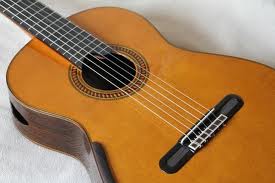


Guitar Review – Paulino Bernabe Model 10 and Yulong Guo Double Top

If you’re looking for an excellent value-for-money instrument, that provides fantastic build quality and superb tone production at a pretty bloody reasonable price then my advice is to most definitely give these two (well, three really…I’ll explain) guitars a play.

The two (well, three….yes, the explanation is coming) guitars offer two completely different guitar-making approaches and therefore two different “feels” in terms of playing. The nature and essence of the guitars is the same in terms of the quality and craftsmanship, but the spirit and the energy produced is different. Not one lesser or greater to the other necessarily. Just different. Which is good because that’s means different players, different people, are being catered for.

Yulong Guo Double Top

What’s China’s history with classical guitar production? Cheap and nasty orange boxes, right? On that basis you may initially be forgiven for thinking that Yulong Guo, a Chinese name, is not the kind of name that one may necessarily correlate with a high-quality, possibly concert standard classical guitar.

Yulong-Guo
Yulong Guo Double Top

Well, that’s changing and let me tell you, the Yulong Guo Double Top ain’t cheap and it ain’t nasty! Well, when I say it’s not cheap I don’t mean to say it’s expensive. What it is, is excellent value for money, particularly when you’re looking at shelling out around $20k minimum for a double top guitar. Anyway, more on the moolah later.

Guo makes a couple of options in his fantastic double tops, which are apparently all the rage with the London conservatorium and university students at the moment. He offers a standard double top, complete with arm rest and Humphrey’s raised fretboard. He also offers this same instrument, but with a sound port in the upper bout of the guitar’s side panel (check out the photo). This little addition (or removal?!) enables the player to get more immediate feedback on what the playing actually sounds like. He does also provide a closure for this sound port if you do wish to close it off.

So now you see why I said three guitars?

Right. So what are they like to play?

I tested a cedar double top with the sound port first, and- oh boy! – what a ride! It was really good fun to play; a completely different experience to a “normal” guitar (i.e. one with no sound port). The sound coming right up at you from the sound port makes it feel very loud and full and strong – I was really compelled to start playing some Barrios on it! This was a really good fun guitar to play, with nice rounded tones and fantastic projection. Some of the treble tones were lacking a little, but this could be perhaps a dissipation of the energy out through the sound port as well as the sound hole? It was a comfortable guitar to play, not too weighty, and a lovely shaped neck profile with reasonably fast fretboard. Overall it felt akin to riding a wild brumby – good quality, hardy stock, that has evolved with all the best bits of what came before it, a bit of fire in it’s belly.

I then contrasted the “with sound port” instrument to that without the sound port. And what a difference a little hole makes.

If the “with sound port” option was a wild brumby, the “standard” option Yulong Guo was more like an Arabian stallion – much more refined, but still as spirited. The “no sound port” option felt much more refined in tone production than the “with sound port”, with noticeably more depth of colour and flavour in the harmonics. There’s a capability of producing some beautifully sonorous cello-like bass tones, as well as some beautifully clear, and rounded trebles. The spirit and the energy of the guitar was the same as the  “with sound port” option, but just a little pared back, and reigned in to a level that I felt was perhaps more manageable overall.

So if you want a guitar with a bit of punch, a bit of spirit, a bit “waaaah”, but still a bit “mmmm” I’d recommend taking a Yulong Guo double top for a ride.

Paulino Bernabe Modelo 10

Well, another

fine specimen of a guitar here (I played the cedar top version for comparison) and COMPLETELY different to the Guo.

The Bernabe (pronounced burn-ah-bay, for all you Anglophones) comes from a strong Spanish heritage and lineage of making fantastic quality guitars. If the Guo is an Arabian horse, then the Bernabe is the Andalusian horse (Google it!) – a breed known for its intelligence and sensitivity. They are also somewhat pliant for their handlers and as such make excellent classical dressage horses and showjumpers…..enough on the history of horses!

PB M-10
Paulino Bernabe Modelo 10

But this guitar is very much like that breed – a very mature-sounding guitar, with a vibrant, rich and extremely well-balanced tonal range. An intelligent-sounding guitar, that responds very well to the player’s touch and what is being asked of it. A guitar that is elegant and sensitive,producing sensual and complex harmonics. However, it is not afraid of a bit of hard work (and really gives to the player) if requested. Nice. Very nice indeed. So, if you’re looking for a guitar with a little bit of elegance, classic Spanish lineage, with excellent show potential, this one could be worth taking for a test ride.

What about the moolah? These guitars are expensive right?

Both of these guitars are currently on sale in Australia for around the $4,500 – $5,000 mark. Which is pretty bloody good!

So, yes, these guitars at this price point represent excellent value for money, in my opinion. Particularly so when you’re looking at the the least expensive quality Aussie-built models coming in around the $5,500 – $6000 mark.

That’s not to say that these guitars go straight head-to-head with, say, the less-expensive Aussie built guitars. No way. These represent different approaches and styes of guitar building that may suit different styles of playing, sensibilities and preferences.

As such they represent an increase in choice at this price point. Well, to be honest, it actually provides a choice at this price point full stop! There’s not much, or there hasn’t really been much to speak of, between the $1,500 – $2,000 and the $5,500 – $6,000 mark.

So this is fantastic news for guitar students looking to upgrade to their first “good” guitar, or for someone looking to get a pretty decent second guitar.

If you’d like to saddle up either of these guitars and take them for a ride send my good friend Pierre Herrero at GuitarsOnline an email: pierre.herrero@telstra.com

He’s lovely chap and will most definitely look after you!