Recording Classical Guitar: Part 2 – Microphone Positioning

Hi folks, following on from the first in a three part guest post from Rick Alexander (here’s the LINK in case you missed it) on how to approach a recording set-up, I have a fabulous post for you from Rick on microphone positioning for optimum sound capture during the recording process.

Over to you Rick!

Recording Classical Guitar: Part 2 – Microphone Positioning

Microphone positioning is one area where recording becomes more of an art than a science.   You do need to experiment in order to get the best results. 
guitar 6

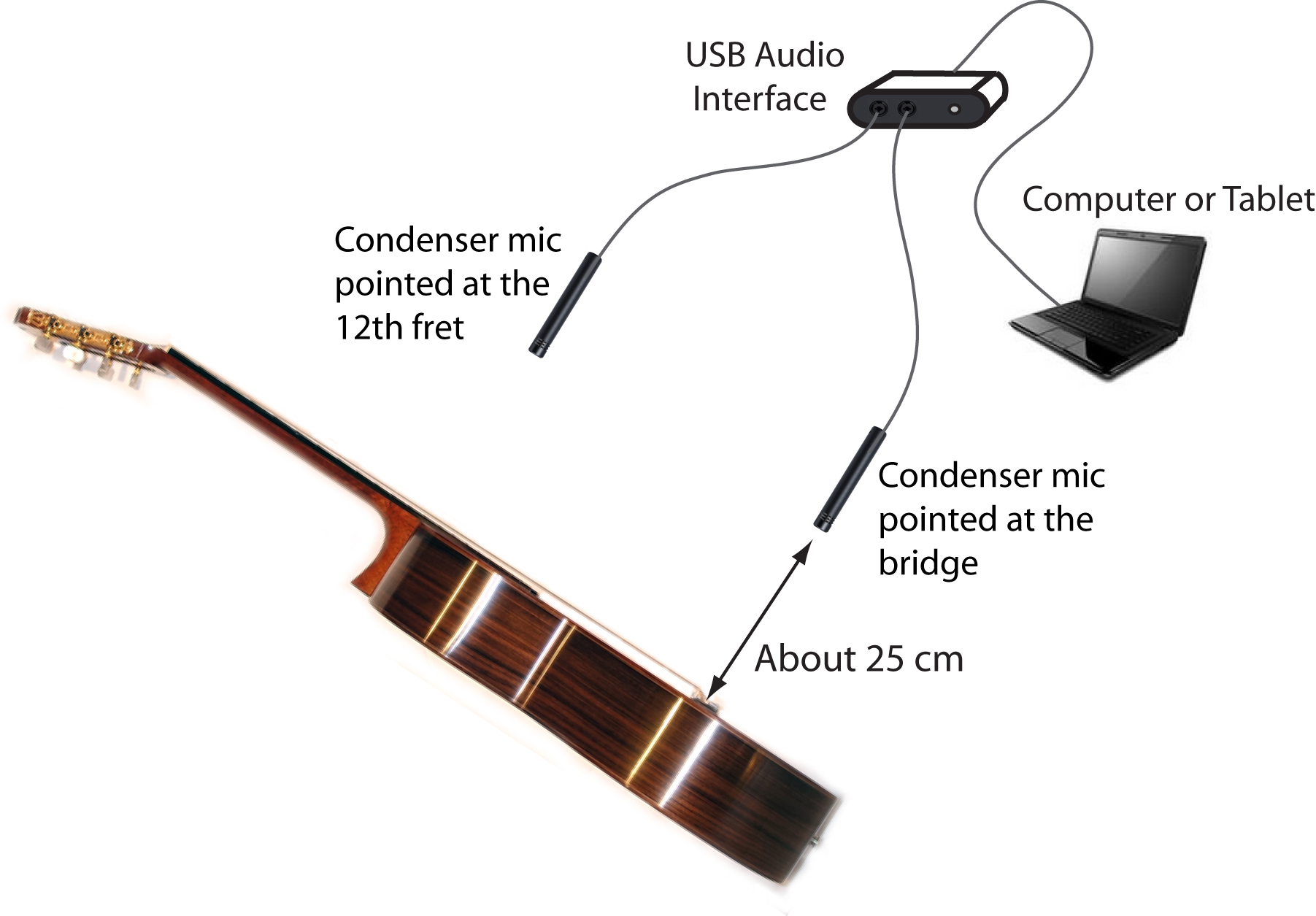
Figure 1 – A mic set up for stereo recording (used for example 1)

Figure 1 above shows a typical setup for stereo recording (see more on stereo vs mono below). Pointing one mic at the bridge, one mic at the 12th fret works well. As noted in part 1, you won’t want the mics too close to the guitar or you’ll get too much bass. I usually have around 25 to 35cm from the mic tip to the guitar. If you have the mics further away you’ll be picking up more and more of the sound reflections from your room’s walls and floor. Unless your room is acoustically optimised you probably don’t want this. Also, an advantage of having the microphones fairly close to the guitar is that this will help the guitar’s sound to outweigh any sound from traffic etc. from outside.

Here is a stereo recording I’ve made with the setup shown in Figure 1.

The microphones I used are Neumann KM184s and the audio interface a MOTU 828 mk3. The guitar is a 1995 Carson Crickmore with a traditionally braced spruce top. The strings are Hannabach high tension Silver Special basses and Carbon trebles (which are fairly bright). The music is the introduction of my piece “Bellbrae” from my CD “Fine Light”. I’ve put the right mic signal, from the listener’s point of view, on the right channel and the left mic on the left channel. (Putting each mic’s signal totally on one channel gives the widest stereo image.) Note that this is a raw recording – I’ve done no adjustment except to adjust the levels of the left and right signals to about the same level and to fade the ending.

Angled mics

I sometimes put the mics perpendicular to the sound board of the guitar as in Figure 1. Alternatively, I angle the mics as in Figure 2, with the mics about 25cm from the guitar. Audio Example 2 is a recording I’ve made with the mics setup as in Figure 2. I prefer the sound of example 2 but the difference isn’t large.

guitar 6

Figure 2 – Angled mic  position for stereo recording (used for example 2)

It’s also worthwhile experimenting with which strings you point at. I usually aim the mic roughly at the 3rd and 4th strings. You don’t need to be too precise but, for example, I think you’d start noticing too much bass if you aimed as far off centre as the 6th string.

If you have a hard wooden floor I’d recommend putting a rug under yourself and the mic stands in order to reduce the guitar sound reflecting from the floor to the mics.

Finally, if you’re recording using a computer I’d suggest setting up so that you can point the back of the mics in the direction of the computer so as to reduce the level of computer noise recorded.

Here’s a good YouTube clip where the presenter demonstrates the effect of changing microphone positions for steel string guitar recording: https://www.youtube.com/watch?v=q2nNXnCBKaw

Mono vs Stereo Recording

You might well ask: why stereo? We only want to record one guitar after all. Also, you’ll often see concert performers only using one mic on their guitar.

But you’ll find that if you record a single guitar in stereo you’ll get a much more realistic sounding result. Especially when listening on headphones. Audio Example 3 here illustrates the difference. The example has a short section of audio in mono then a short section in stereo followed by longer mono and stereo sections. I’ve used the setup in Figure 2 for the stereo section and the mono section is just the right channel from the stereo recording.

I did also try using the bridge mic for this mono example but thought the neck mic sounded better.

Mic Stands

K & M make good quality mic stands. They have a small stand, K&M 25950, which is particularly useful for classical guitar recording. http://www.sweetwater.com/store/detail/KM25950 Using this stand lets you avoid having the large boom of a typical mic stand cluttering up your room.

Audio Interfaces

In the next post I’ll discuss options for the audio interface used to interface the microphones to your computer.

Interview with Canberran Classical Guitarist Extraordinare Minh Le Hoang – Part 1

I was very fortunate this weekend just gone, folks, to interview the supremely talented classical guitarist Minh Le Hoang ahead of his solo concert with the Melbourne Guitar Foundation on 9th May.

Minh Le Hoang

We had a great chat (he’s such a lovely, funny laid back chap), with Minh talking about the work he does in Vietnam, keeping familiar pieces fresh and his feeling on solo versus group performance.

As usual, I’m splitting the interview across a couple of posts for you.

Here you go……

Tell us a bit about yourself – who is Minh Le Hoang?

A bit about myself? What a question! You always feel funny talking about yourself. I’m based in Canberra, forever. We came from Vietnam in the early 1990s, as a teenager, and we settled here ever since., 24 years ago.

And I started classical then. When I was in Vietnam we played pop guitar, with steel strings, chords and whatever was around at the time. So I got into classical music here, and got into music through high school and went on and studied with Tim (Kain) for, you know, forever still! To this day!

So at the moment I’m just teaching at the Canberra School of Music (at Australian National University) and round a couple of private schools. That’s my main teaching job.

I perform solo, in duo with a flute player (a friend) and trekking with the boys (Minh is a member of guitar quartet, Guitar Trek). We’re preparing for a new CD in June.

I guess my solo activity has been going back to Vietnam quite often, to where I come from, once a year for the last 10 or 12 years. So I go back and do a few solo gigs and teach a bit there at the Conservatorium, share a few ideas, show them stuff we learn here. The kids over there don’t get the same sort of input so I try to contribute whatever I can.

Is there much interest in the classical guitar in Vietnam?

Yeah! It’s huge! Basically everybody plays guitar you know, whatever style. The classical guitarists there being years, and friends of mine organizing international festivals. This year they’re doing the second one. For Vietnam it’s quite a big step up.

Quite a lot of young, talented players but they don’t get the same sort of teaching you know. It’s all mostly self-taught. Even the teachers there, you know, are self-taught!

We’re very excited here in Melbourne that you’re playing a gig with the Melbourne Guitar Foundation on 9th May (check out further info here folks: http://www.melbourneguitarfoundation.com/events) – what are you going to play for us?

It’s a varied programme, a mixed bag of old and new repertoire I’ve been ticking over the last 6 months or so.

So there’s some Bach, the first lute suite in E minor BWV 996. A lot of Spanish music, there’s Asencio’s Colletici Intim. You’ve probably heard that one a lot, probably sick of it, everybody plays it you know!

There’s Rodrigo’s Invocation y Danza, some Torroba and a set of South American pieces – three Brazillian pieces and a waltz. So there’s a mixed programme of Latin, Spanish and Bach. The Bach is the odd one!

There’s no hardcore difficult listening in there. It’s all accessible I think.

Is there any rhyme or reason as to why you chose those particular pieces?

No, not really. There’s just some of my favourite pieces I like to play, some of those Spanish ones and it’s there under the fingers.

At the moment I’m doing a lot of teaching and not performing, on the road all the time, so you need to fall back on some of your more familiar pieces. But the Bach and the South American pieces are relatively new, yeah

How do you keep those very familiar pieces fresh?

That’s tricky. It all depends on how much time you have you know!

I guess the older you get, the more you teach, the more you form your own idea of how you interpret the music. I try to, you know, make the most out of what I know when I come back to pieces.

Some of it is still fresh because you’ve gone through different phrasings and articulations and you have better fingerings. In that way it’s still fresh even though you still have your memory of how the piece sounds.

Or you may change totally, looking in the score and saying “why did I do that?!” you know?

It’s only dangerous if you play the Chaconne when you’re 12 or 15 then you come back to it. It’s pretty dangerous, you have this notion of the piece formed as a 12 year old. Some people never tend to play it better. They took on this massive work when they were really young and they can’t change it.

We know you as a member of the enormously influential and world-renowned Guitar Trek, and you also play with a duo partner. Playing in a group or ensemble environment versus playing solo are quite different experiences – do you have any preference as to solo versus group playing?

Oh that’s a difficult question to answer. I actually enjoy doing both you know, solo and chamber music. But approaching the concerts for solo or chamber is so different.

When you’re playing solo you’re basically more exposed, you’re naked on stage really! It’s a lot more stressful doing solo, you know. Generally the repertoire’s harder, physically harder.

But there are also challenges in playing chamber as well. It’s playing with others. You’ve got to have a rhythm, you’ve got to prepare the parts as well as you can because you can play your part as well as anybody in your room on your own with a metronome. With the four or the two of you guys you tend to go off somewhere! It’s really hard.

But I do enjoy performing and touring with the guys, doing solo on a tour you can get a bit lonely. You get to hang out by yourself and do your own thing. With four guys it’s always much more fun! I enjoy both though I don’t have any preference.

—-

Head back this time next week folks for the second part of the interview!

Happy playing!