Album Review – Un Viaje Mistico by Daniel Nistico

Frequent readers of the blog will most likely be aware of the young, rising Melburnian talent that is Daniel Nistico. If not, or if you’re new to these parts, check out these posts on Mr Nistico:

https://classicalguitarnstuff.com/2013/04/15/an-opportunity-to-be-a-part-of-daniel-nisticos-first-album-un-viaje-mistico-a-mystical-journey/

https://classicalguitarnstuff.com/2012/08/25/introducing-rising-star-of-the-classical-guitar-daniel-nistico-ooh-and-hear-about-the-adelaide-international-guitar-festival-too/

Well, Daniel has been in the recording studio recently recording his debut album (financed all through a Pledge Music project). And what a debut recording it is. I promise, cross my heart, hope to die and all that, dear reader, that I’m not just saying that because I know the chap – this is a truly fantastic recording and has been playing on heavy rotation here at Classical Guitar n Stuff Towers for the last few weeks.  Dan Nistico_July2013
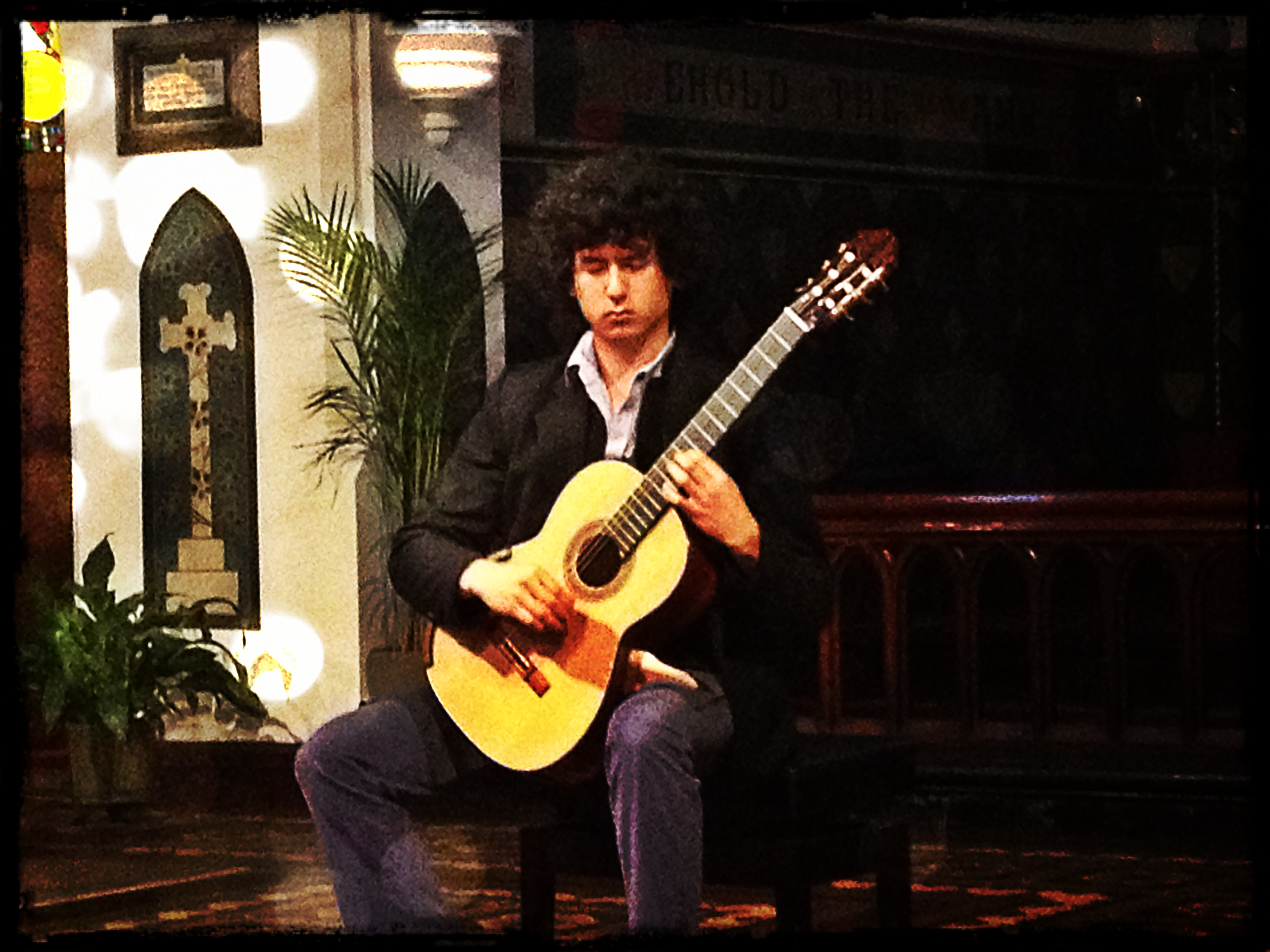
First up, the playing right across the album is just superb – yes, Daniel’s weapon of choice is a rather tasty Greg Smallman guitar, but he has the talent (and more) to match a guitar of this calibre. His tone is personally very inspirational for me, and I urge you to take a listen to understand what a good clear, full, fat tone without the slightest element of schmaltz creeping in really sounds like.

Daniel has put together a fantastic programme, with some well-known favourites on there as well as some lesser known material – a good balance between the two in fact, in my opinion.

The album opens with some cracking Barrios – the Mazurka Appassionata – and a simply beautiful rendition of the full Le Catedral suite. The fifth track on the album is the absolute stand-out for me and this is Daniel’s own transcription and interpretation of Sevilla by Albeniz – I love this!! Yes, it’s a well-worn favourite, but Daniel’s interpretation brings a quality that I’ve not heard in many recordings. It’s rather laid-back, unhurried, unfussy and the lines, voices and phrasing within the music are so very clear. I’m not sure of Daniel’s approach to this piece, but it feels almost like a guitarist’s interpretation of a pianist’s interpretation of guitar music. I love it! I may even be so bold as to say this is currently my favourite recorded version of Sevilla. Nice work Daniel!

Continuing on with the Spanish flavour, but with a slightly more contemporary feel is the Collectici Intim suite by Vicente Asenci (written in 1965), showcasing Daniel’s virtuosic flair as well his gorgeous rounded tone, and fantastic sense of phrasing (check out in particular IV La Gaubanca).

Moving away from Spain, Daniel brings us home to Australia with Phillip Houghton’s Kinkachoo I Love You. This lovely, mellow piece is a lovely choice in the programme to follow the rapid fire final movement of the Asenci suite.

The album is then rounded out with two absolutely stunning pieces (two that I’ll admit I’d not heard of prior to listening to this recording) and come joint second favourite for me after Sevilla. These pieces are Sonatina….after an enchantress by American composer John Anthony Lennon and the exquisite This morning in Omagh the sun rose again by William Lovelady. This piece was written as a tribute to the 29 people that lost their lives and 220 that were injured in the 1998 car-bombing in Omagh, Northern Ireland. Daniel’s suitably impassioned playing on this piece is very sensitive to the inspiration for this piece and is quite simply beautiful. Actually on reflection, this one is joint favourite for me alongside Sevilla. I’ve just had the privilege this evening (I’m writing this on Sunday night) of having just seen Daniel perform this live this evening in Melbourne. Breathtaking…….

This album is a must if you’re a lover of guitar music, and looking to broaden your horizons with some newer or little-heard repertoire. Hop onto Daniel’s website for details of how to get your mitts on your own copy of his album. It’s a must!!

www.danielnistico.com

And watch this space for a Q&A with Daniel before he heads off Stateside to continue his studies and grow his career at the Eastman School of Music.
 

Guitar Review – Allan Bull Guitars

One of the great privileges I have in writing this blog, aside from writing for you good folks twice a week, is taking receipt of some fantastic gear (albeit temporarily) to play around with for a bit and review – all course with you, dear reader, in mind to inform and delight! Oh OK, and to have fun indulging myself too……

So, my latest privilege this last couple of weeks has been playing around with two guitars from one of Australia’s top luthiers, Tasmanian-based Allan Bull. I own a 2008 Allan Bull guitar, so the opportunity to see what Allan had been up to of late, the progress and development in his design and sound was an absolute must for me!

This past couple of weeks I’ve been getting to grips with a new fan-braced spruce top and a cedar top with asymmetric grid bracing from the Bull Guitars stable, road testing them and having some of my students play them to get their thoughts and reactions and to hear how they sound from an audience perspective. It’s a tough gig, but someone’s got to do it!

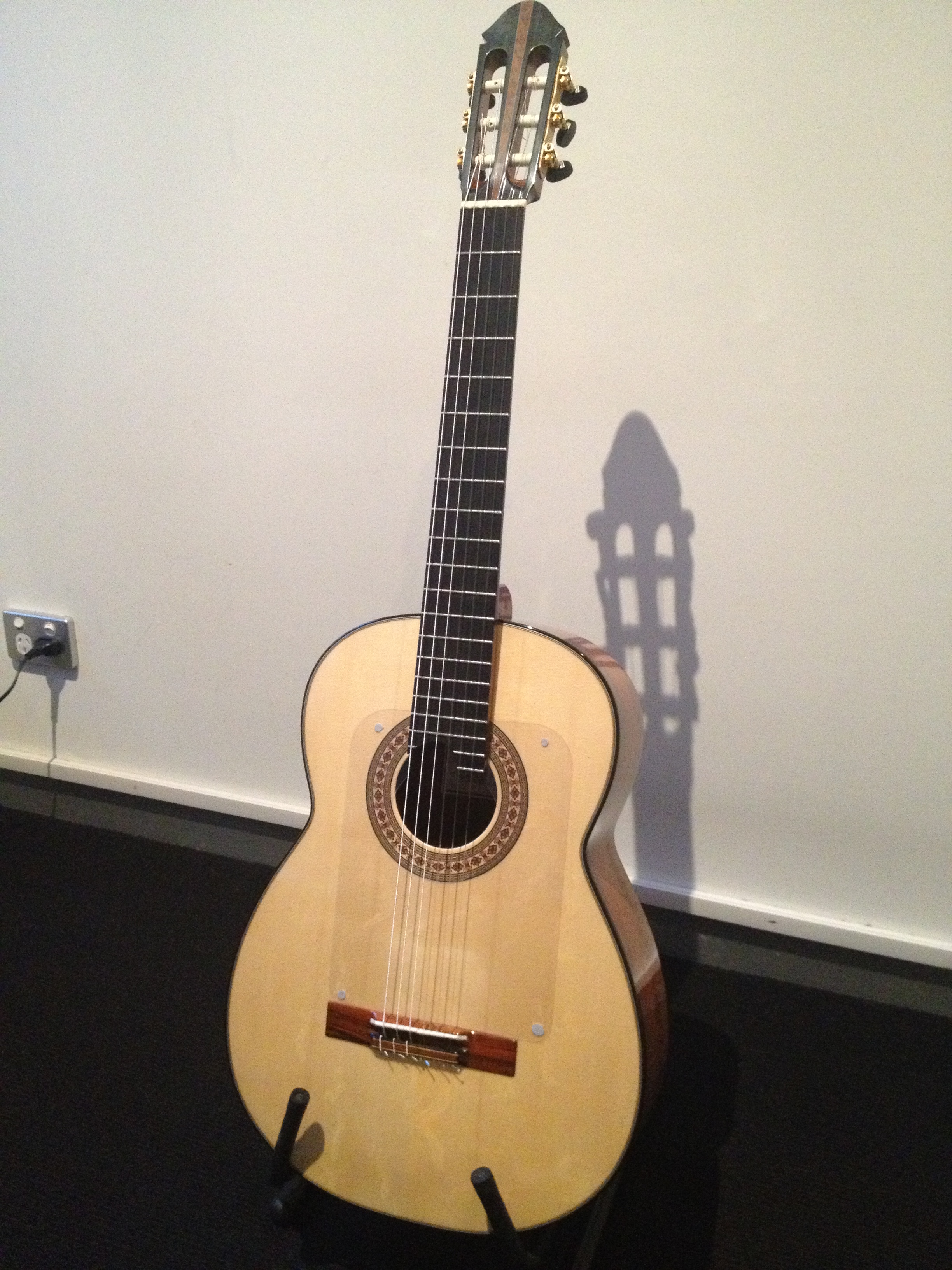
First up, let’s take a look at the spruce top. This guitar is probably the closest of the two to the 2008 spruce top model that I own, but it is quite a different beast. Not a massively helpful comment for you, dear reader, I appreciate. What I mean to say is that Allan’s design and guitar building techniques have quite clearly continued to progress in a really positive direction.  And when I say that I don’t mean to say that the 2008 model was a bad guitar (far from it) – it’s just fantastic to see the concept of continuous improvement at play here.

The spruce top  has the full-bodied physical weight of similar Aussie-built guitars – a good sturdy instrument, which is going nowhere when playing. You feel like you can give it a bit of welly without feeling like you’re going to break it. The neck has a similarly sturdy feel, somewhat substantial, and not an overly fast neck and fretboard for my hands, although beautifully finished and a pretty nice feel overall for the left hand.

The timbers selected for the instrument itself, as always with Allan’s guitars, are of fantastic quality and visually striking. The pale, white blonde colouring of this particular spruce is striped through with an intriguing bearclaw pattern (much prized by some guitarists).

photo-2
Bull Spruce Top (with protective soundboard shield just for demo purposes)

The spruce top, much like other fan-braced, and particularly the Aussie-built guitars, has a lot of power – to say you don’t really have to milk the guitar is an understatement! So it’s a powerful guitar, with that great thick fan-braced kind of sound, but it also delivers clarity in this too. The tone production is probably a little too direct for my own personal taste – the primary note is very clear and distinct, but the tonal depth, the character delivered by the presence of overtones (which aren’t that apparent from the guitar) is perhaps missing from this instrument (although I understand this may appeal to those with flamenco preferences).

It’s also worth bearing in mind that spruce tops do tend to send a lot more direct, bright and “zingy” when brand, spanking new. This type of timber can often take 12-24 months to really open up and reveal the full depth and warmth of tone. My 2008 spruce top model, for example, took around 18 months to fully open up. I’d really love to hear this instrument when played in and the wood opened up and coming into its own.

The overall finish and attention to detail on this instrument, as with the cedar top too, I am really impressed with – the rosette, the bridge, the headstock, the purfling are all really well done indeed. Really top quality.

The cedar top with asymmetric grid bracing is most definitely my favourite of the two guitars tested and an absolutely fantastic instrument in my humblest of opinions. It shares all the quality build features, attention to detail, physical weight and playability of the spruce top, but has a completely different tonal “feel” and sound. As Allan often does with is cedar tops, with this particular model there is a rather attractive blonde “stripe” running through the middle of the soundboard. There’s no mistaking an Allan Bull soundboard, that’s for sure!

The sustain from this guitar is awesome! You can strum a chord or even a single note, put the guitar down, go away, make a cup of tea, check the mail, come back and the note will still be ringing on! OK, maybe that’s a bit of an exaggeration, but you get the picture. Great sustain like this makes for really easy legato playing.

photo-1
Bull Cedar Top with attractive blonde stripe in the soundboard

It has a lovely warmth to the sound, which one might expect from a cedar top, with really fantastic projection. The depth and character of tone is nicely rich too, with much more obvious presence of overtones delivering that character.  This guitar was a real joy to play and found myself very happily playing this for a good hour or so. Definitely worth a look at if you’re interested in a quality, Aussie-made cedar top.

All in all, both of these instruments are of fantastic quality and neither of these would be a bad buy at all – I’d consider both a pretty good buy in fact. Which one you might choose to go for – the bright and direct spruce, or the warm and more characterful cedar is up to your own personal choice. The cedar top is a full-bodied shiraz in comparison to the spruce’s pinot gris (and just like Alsatian pinot gris, I think this one will age well) – both nice, just different and suiting different tastes for different occasions.

If you’re in Melbourne and you want to check out the Bull Guitars for yourself give Pierre Herrero at Guitars Online a call: http://guitarsonline.com.au

Or head over to Allan’s website to find out more about his design philosophy and his wonderful instruments: http://www.bullguitars.com