New Album Review: Milos – Aranjuez

You may remember a couple of weeks ago I was getting very excited with the imminent arrival of Milos Karadaglic’s third studio album, AranjuezWell, folks, the eagle has landed!

Photo courtesy of Mercury Classics. Copyright Lars Borges / Mercury Classics

For his third album on Mercury Classics/Deutsche Grammophon, Miloš Karadaglić takes the Concierto de Aranjuez as the starting point for a journey across the Spanish landscape, paying tribute to the great music and musicians that placed the modern classical guitar firmly on the international stage.

The album hit the shops (high street and digital varieties) on Monday this week (17th February) and the lovely people at Mercury Music were kind enough to send me an advance copy though so I could get my listening gear around it and give you a bit of a synopsis of what you’re in for when you head to the shops, or iTunes or wherever to get yourself a copy (because I promise you that you’ll want a copy).

Here’s the track list for you:

Joaquín Rodrigo: Concierto de Aranjuez

01. Allegro con spirito 05:58

02. Adagio 10:52

03. Allegro gentile 04:42

Manuel De Falla

04. Homenaje pour le Tombeau de Claude Debussy 03:52

05. Danza del Molinero (“El Sombrero de Tres Picos”) 03:02

Joaquín Rodrigo

06. Invocación y danza 09:14

Joaquín Rodrigo: Fantasía para un gentilhombre

07. Villano y Ricercare 05:07

08. Españoleta y Fanfare de la Caballería de Nápoles 10:20

09. Danza de las hachas 02:01

10. Canario 04:58

As the name of the album suggests, the headline piece presented on the album is Rodrigo’s masterpiece the Concierto de Aranjuez. I was impressed by the little tid-bits of the Concierto released on YouTube in the lead up to album launch and I can say unequivocally that I wasn’t disappointed. This is most certainly a key piece within the classical guitar repertoire and probably a concerto that any professional guitarist worth his or her salt would want to tackle.

Well, Milos does significantly more than tackle the Aranjuez. I don’t think it would be going too far to say that he has mastered it. The second movement, the Adagio, in particular is stunning. My favourite of the three movements and potentially my favourite on the whole album. It’s a well-worn and well-trodden path that Milos treads with this concerto and the second movement is so well known too, but he (and the London Philharmonic Orchestra) play it with a beautiful sense of gravitas, with none of that sense of schmalz which can sometimes creep into this movement.

Milos’ tone production is just fabulous in this movement too, as it is throughout the whole album (and well captured in the production). I particularly love the moment around 7:35 into the Adagio, he plays with the most sumptuous, bassoony tone. Rich and velvety. This is inspirational stuff. This is the kind of tone one should be seeking. Its the kind of thing I’m always striving for in my playing anyway, to always produce that deep rich, cello-esque tone. I urge you to listen and absorb.
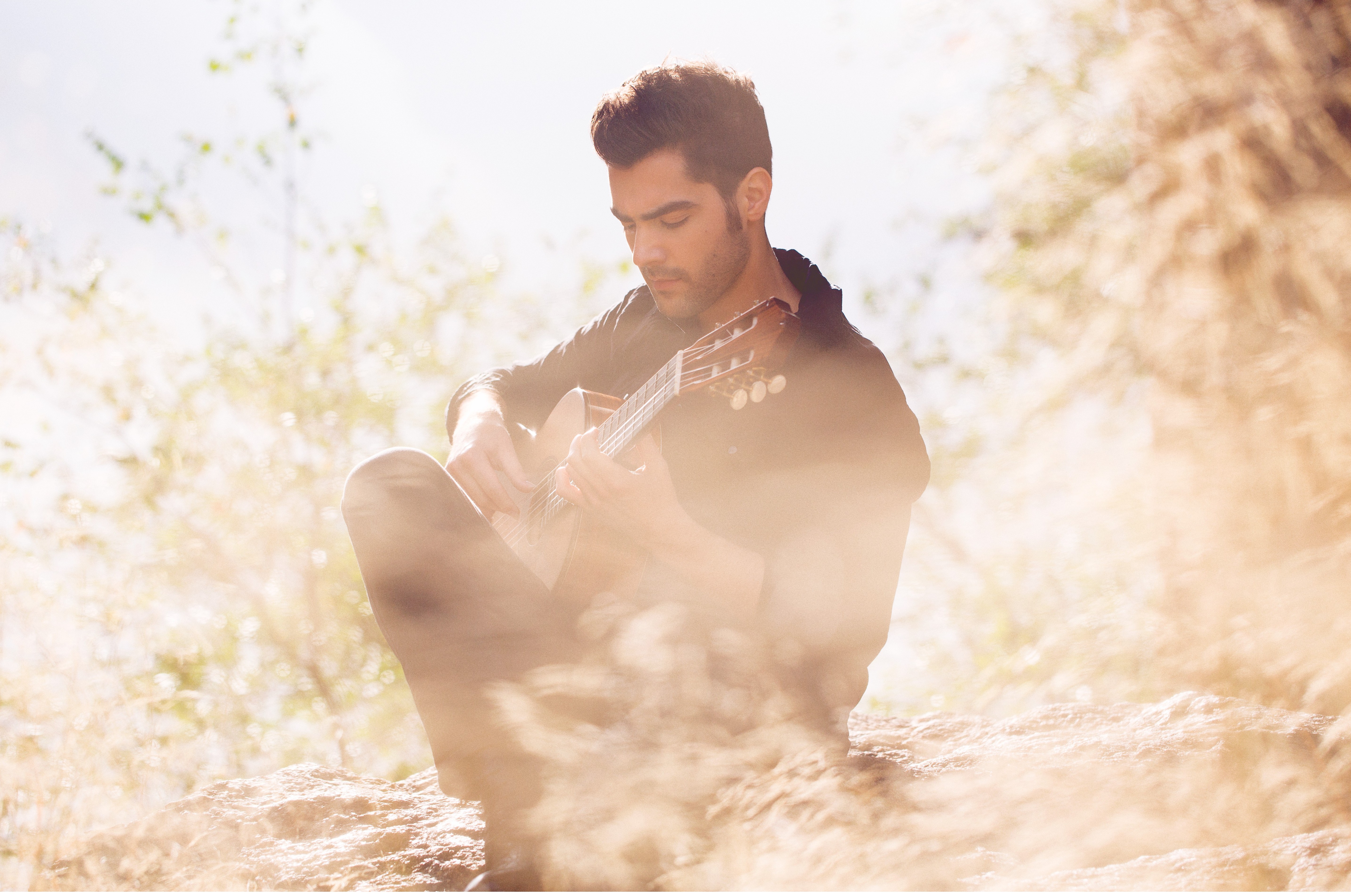
Photo courtesy of Mercury Classics. Copyright Lars Borges / Mercury Classics

And the strumming section that follows,  building through a great crescendo to the 8:13 mark, is tastefully executed too,. Not all guns blazing, lets go crazy, but subtly powerful.

I think Milos is starting to come of age as a musician with this album. it’s a very grown-up sounding album, awesome playing both technically and musically without being flashy, musically informed interplay between the orchestra and Milos the soloist, subtle in its approach and styling. Beautiful tone and exquisite attention to detail in the phrasing (in both the orchestra as well as Milos himself). A mature and elegant recording if ever there was one.

I think I might even go so far as to say that I think this might be up there now in my favourite renditions of the Concierto. And please understand, that’s not something I say lightly!

Following the Aranjuez is the de Falla Homanaje (one of my favourite pieces in the classical guitar repertoire), which is just divine. It has a really rich, sultry quality to it that I just love. Man, those basses on that Smallman are so big, fat and juicy (of course, aided just a little bit by the man playing them!).

Milos’ approach to the Danza del Molinero has that fantastically masculine, Iberian sensibility about it, particularly the opening section. His big, fat broad rasguedos completed just nicely with dolce but not overly saccharine melodic sections. Nice. Very nice. This track has had quite a few plays already. A highlight for me on this album. Up there, contending with the Adagio from the Concierto de Aranjuez as my favourite track. Just love playing that intro section over and over…..

Rodrigo’s Homanaje de Manuel de Falla Invocacion y Danza is also artfully represented here by Milos. Again the sections where a guitarist could go completely nuts (i.e. around the 7min 39 sec and 8 min 37 sec marks), Milos just holds enough back for this to be a very elegant, subtle and enchanting interpretation.

And what can I say about the final suite on the album, Rodrigo’s concerto for guitar and orchestra Fantasia Para Un Gentilhombre? Well, I’m running out of superlatives! With completely the running the risk of sounding overly gushing and also repeating myself, the tone Milos produces in all movements of this suite is absolutely top drawer stuff. My particular favourite movement is the second movement, Españoleta y Fanfare de la Caballería de Nápoles, where Milos explore just a great range of colours on the guitar and plays just superbly with the orchestra (the marvellous London Philharmonic Orchestra).

For all guitarists, guitar aficionados and classical music lovers alike, this album from Milos is a must. With this album we are witnessing a fantastic talent blossoming into a true artist.

Beguiling. Powerful. Elegant.

Photo courtesy of Mercury Classics. Copyright Lars Borges / Mercury Classics

UK Classical Guitarist Jonathan Prag at the Adelaide Fringe

Jonathan Prag had a busy year in 2013, touring the UK, before returning to the Edinburgh Fringe and the atmospheric C Too (church) venue at St Columba’s by the Castle. He has set his sights on the wider world this year however, and for the first time will appear at the Adelaide Fringe.

Jonathan is known for taking his audience on a journey through some of the world’s most beautiful music. In this programme, two Scottish folk songs get the classical guitar treatment and we hear Bach, Lauro, Satie and Gershwin. This is a friendly performer who sets the audience at ease by his ability to provide just the right linking comments.

Jonathan juggles a demanding guitar teaching schedule with performing. He plays in hospitals and hospices all over the UK for the charity Music in Hospitals, working both as a soloist and in the Ruskin Ensemble violin and guitar duo. His calendar for 2014 also includes a stint at the Toronto Fringe in July before once again returning to Edinburgh.

Jonathan Prag
Jonathan Prag

Jonathan Prag will be giving an Adelaide Fringe debut to works by two contemporary British composers for the guitar; Vincent Lindsay-Clark and Matthew Sear, both eminent classical guitarists, have given their blessing for Jonathan to bring their music to the Fringe audience. Lindsay-Clark’s piece, ‘Salsa Roja’ is a brilliant tour de force and was specially commissioned by the world famous Paraguayan classical guitarist Berta Roja. The piece if fiendishly difficult and technically demanding. No less dynamic and exhilarating is ‘America’ by Matthew Sear –in which America – from the Big Apple to the Keystone Cops; honking traffic to the haunting blues – is evoked in a magical soundscape.

Jonthan will be playing the following shows:

FRI 28th Feb – Migration Museum – 6:00pm 80 mins – 82 Kintore Ave, Adelaide- Adult$18.00 Concession$13.50 Companion Card

SAT 1 Mar – 8:00pm 80 mins – HATs Courthouse Cultural Centre – 4 St Vincent St, Auburn – Adult$18.00 Concession$15.50 FringeBENEFITS$17.00 Companion Card

SUN 2 Mar – 6:00pm 80 mins – Church of the Trinity – 318 Goodwood Rd, Clarence Park – Adult$18.00 BankSA Customer $16.00 – Concession$15.00 FringeBENEFITS$16.00 – Companion Card

FRI 7 Mar – 7:30pm 80 mins – The Singing Gallery – 133 Main Rd, McLaren Vale – Adult$17.00 Concession$15.00 Companion Card

SUN 9 Mar – 6:30pm 60 mins – Ayers House Museum – State Dining Room – 288 North Tce Adelaide – Adult$18.00 Concession$15.00 Companion Card

If you’ve not done so already grab tickets for Jonathan’s show here: http://www.adelaidefringe.com.au/fringetix/classical-guitar-jonathan-prag/4bf5241f-fc16-4339-b5cb-36e446601de6

And now for a Q&A with the man himself!

To give you a taste of what’s in store, and some words of wisdom, Jonathan kindly agreed to the famous Classical Guitar n Stuff Q&A! Lucky us!

Welcome to Australia! It’s great to have more talent such as yourself visiting our shores. What program are you going to be playing at the Adelaide Fringe?

Thank you for the warm welcome. My program is going to be a Prelude by George Gershwin (written originally for piano), then Bach’s Prelude from the Cello Suite No. 1, which, many years ago, I used to play on the viola; then on to one of the contemporary composers I’m playing – Vincent Lindsey-Clark. I’m playing ‘Salsa Roja’ from his ‘Fiesta Americana’ Suite which Berta Rojas commissioned him to write for her. There was a wonderful occasion last year when she came to the UK and performed the suite for the first time in the church in Vincent’s home town of Whitchurch in Hampshire, not far from Southampton, where I’m from. Next I play ‘Niel Gow’s Shadow’ which is an arrangement by the guitarist Neil Smith of 4 traditional Scottish tunes; then it’s ‘Lipa Vekovaya’ by Serge Rudnev. I really like the Russian-ness of that piece. It’s very moving. After that it is Matthew Sear’s piece – ‘America’. Matthew is a young guitarist and composer from London and this piece is full of exuberance and paints a vivid soundscape full of his impressions of the America of the imagination. He wrote it after his second visit to the States because his second visit captured his imagination and he wanted to express that. Then I play ‘Gnossienne’ by Satie –then I finish with ‘Tryptico byAntonio Lauro. That’s the basic program, and there might be one of two additions depending on whether I’m playing with an interval or not. So at some venues I’ll probably be adding in a mal Waldron Blues called ‘Left Alone’, ‘Asturias’ by Isaac Albeniz and ‘Herencia Latina’ by Paco Peňa. I like a bit of flamenco!

What was the inspiration for your program?

I’m inspired by all the different moods that the guitar can capture and express and I also love the way that folk music has formed the basis of many pieces in the repertoire. Antonio Lauro, for example, was inspired by the traditional folk tunes of Venezuela and Serge Rudnev has based ‘Lipa Vekovaya’ around a traditional Russian folk song. The Scottish pieces are another example and flamenco is a folk tradition also. But if I was to say what my biggest inspiration was it would have to be J.S. Bach. It was his music, which at first I played on the viola, that made me want to play the guitar. I never perform a concert without playing something by Bach. I never practice without including a piece by Bach and I love listening to all Bach’s music. Although I love other composers – Schubert, Beethoven, Bela Bartok (I could go on for a long time here!) I think you could say that I am a musician because of Bach.

Are you playing anywhere else whilst you’re here in Australia?

No, just in Adelaide this time although I’d love to visit other parts of Australia.

What else are you working on at the moment and what can we expect to see and hear next from you?

I’m preparing another piece by Vincent Lindsey-Clark and I’m working with Matthew Sear again also. I hope that I’ll be doing some duos soon but watch this space. I started out in a duo with the guitarist Adrian Neville and I really enjoyed working with him. Then I went solo and Adrian became a distinguished teacher at Winchester College and I was too busy to get into another duo although I do still play with The Ruskin Ensemble, usually as a cello, violin and guitar trio. But I miss playing in a duo.

As a musician, what music excites you the most and why?

Well I’ve already admitted that Bach is my ultimate constant inspiration but there certainly are other kinds of music that I get very excited by. South American music – I’m playing Lauro this time but if I wasn’t I’d be playing Barrios or Piazzolla. I’m interested in exploring the possibilities of improvisation although jazz guitar has never been something I’ve felt qualified to play. I did play guitar for a couple of years in a cumbia band –and helped on vocals. South American music again. It was great fun and really invigorating. I also really like early Fleetwood Mac and Creedence Clearwater Revival – oh and Bob Dylan. I’d better stop or I could be here for a while!

Which guitarists do you find the most exciting and inspiring?

I can still remember the first time I heard the recording of Segovia playing the Bach ‘Chaconne’ – that was it – I was hooked. I like Julian Bream for the sound he produces and the Lute recordings of Bach he did. I like the way Carlos Bonell plays, and David Russell. Berta Rojas is wonderful of course and Paco de Lucia– there are so many amazing guitarists. And he isn’t a classical guitarist but I really like Richard Thompson. This is a hard question!

When you’re not practicing and playing what activities do you get up to?

I play squash – in fact I’ve already been in touch with the South Adelaide Squash Centre to fix up a game or two while I’m here – I like cycling, going to the theatre and listening to music. I love going to football or rugby matches with the family. We have four grown up children so it’s a very jolly occasion when we all get together on one of those excursions. I love travelling and seeing the world and sampling good food… all the things most people like really.

What top tips can you offer folks who are learning or thinking of learning the classical guitar?

Well, definitely to take your time – there’s no forcing it. If you can do something on the guitar slowly, even if there is a 10 second pause between each note, then one day, by doing it slowly, you will also be able to do it fast. You need patience. The other thing is to enjoy the music – I mean by that to listen carefully to what you play – each note. Hear and enjoy the music in the way each note combines with the others, as you play them. By enjoying the music at each stage of your progress you gain motivation to keep going. It shouldn’t be some kind of torture you put yourself through. There’s no virtue in making yourself suffer.


Wise words indeed Jonthan – thanks! And all the best of luck for Adelaide. Enjoy!

You can check out Jonathan’s blog at:  www.JonathanPragClassicalGuitar.blogspot.com