New Album Review – Bach on Fire by Lily Afshar

Once again I am in the privileged position as a classical guitar blog writer to receive an advance copy of the latest recording from one of the planet’s finest guitarist. This month it is the latest recording from the wonderful Lily Afshar.

It only seems a moment ago that Lily was releasing her last album with October 2013’s Musica da Camera (which we, of course, featured a review of too. Check it out here.)

Bach On Fire

Bach On Fire (Archer Recordings) is Afshar’s seventh offering and, as the name suggests, takes us through some of J.S. Bach’s most cracking works including Cello Suites, PreludeFugue & AllegroLute Suites and Ave Maria. As Lily so clearly demonstrates through her own personal transcriptions of lute and cello works, Bach certainly indeed was on fire. As is Afshar herself at the moment. Not only is this recording following on only six months (or thereabouts from the previous recording), but all the transcriptions on the album are transcriptions that Lily has made herself – this record should be called Lily on Fire!

Bach on Fire draws its title from these innovative arrangements of Afshar’s. These, according to the woman herself, allow for more interpretive phrasing and dynamic nuance and, ultimately, a more exciting performance. And to be honest this really does come through in the recording. The music, which is music we’re all very familiar with, has a fantastically fresh and vibrant quality to it. That’s no mean feat I can tell you. Kudos to Afshar.

Bach on Fire features:

  • Lute Suite No. 4 in E Major, BWV 1006a
  • Cello Suite No. 1, BWV 1007, 
  • Prelude, Fugue, and Allegro, BWV 998, 
  • Cello Suite No. 3, BWV 1009
  • Ave Maria

My particular favourite on the album is the arrangement of Cello Suite No. 1 (BWV 1007) – the Courante has that sprightly, “running” quality that a courante should have. Lily also manages to really capture the warmth and depth of the cello, with very clear lines (so important in Bach), and making the music sound as if the guitar is its natural home. I must get my hands on a copy of this score.

I must also make mention of Ave Maria too which, for me, is one of those tunes that usually makes me go “ohhh, not again….“. In this instance though, Lily manages to capture and communicate the simple beauty inherent in the music. A simple, unfussy, clear arrangement that, again, sits so very well on the instrument. Listening to this recording makes me feel rather excited and want to play it all for myself! On fire indeed!


Afshar’s new arrangements are the result of many years of experimentation and watching students struggle to play Bach. Knowing that the amount of bass notes and poor fingerings posed a technical challenge for most players, Afshar employed techniques like cross-string fingerings to make the music sound as if it were written for the guitar.

After years of using whiteout, pencil and eraser to adapt other Bach guitar arrangements, I decided to make my own editions from scratch,” she says. Afshar arranged 42 Bach movements which were published by Mel Bay in 2013 as Essential Bach: Arranged for the guitar by Lily Afshar. (Note to self: I must check this out!).

This recording offers a fresh approach to playing Bach,” Afshar writes in the album’s liner notes. “My purpose is to make Bach accessible to a wider audience and encourage guitarists to play them more. Many others have arranged Bach pieces for the guitar, but my arrangements are quite different.”

Whether you’re a lover of classical guitar, Bach, or want to hear what some absolutely top-notch arrangements of some of Bach’s seminal works played by a top-notch guitarist you definitely need to check out Bach on Fire.

Album out June 3 via Archer Records

 

image001

The Best Time To Practice Guitar

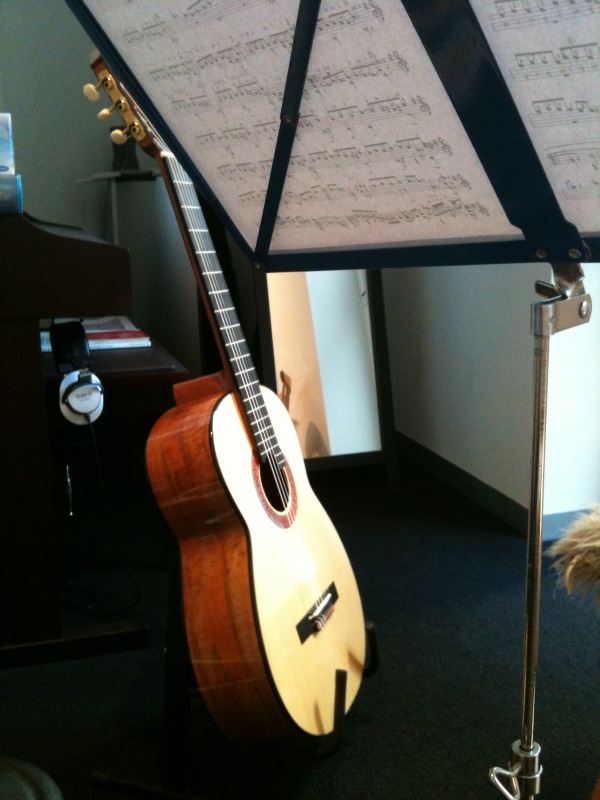
guitar_photo.jpgIt may sound daft, but I believe there are certain times of the day (for myself at least) that are waaaaaay better for practicing than others. For me a 30 minute or 60 minute period is not equal throughout the day. There are 30 minute or 60 minute “slots” that are worth significantly more in terms of output, results, progress and fruitfulness (call it what you will) than other times of the day.

The following outlines some of my own direct experiences with the best times to practice. I’m not saying that they’re going to be the same for all as we’re all wired differently and some of us are early birds and some night-owls and so on. Have a little read though, soak it in and perhaps use it as a guide to help you figure out the best times for your own practice.

1. 12 – 24 hours after a lesson

Whatever you’re working on with your teacher, and whatever level you’re at, in order to really maximise the time and effort spent in your lessons it’s really a must to sit down with the guitar and have a good practice session recapping things you were working on within 12 to 24 hours of a lesson.  And when I say “good” I’m not necessarily talking about a specific length of time here. I am talking about quality. Make sure you’re really focussed in on the things you were working on in the lesson, almost to the exclusion of everything else.

I’m not so sure about going home and practicing right away after a lesson. You’ve got to give your brain a bit of a break and a chance to assimilate the information you’ve just fed it.

Coming back to the instrument and honing straight in on the things you were working on within 24 hours of your lesson is key – your rested brain will have a reinforced message, you may find things occur more easily as a result of that rest. Importantly, not allowing more than 24 hours slip by between lesson and practice session means that you’ll have a greater chance of remembering things you and your teacher were working on!

If you can’t manage the other ideas here, please please please (please!) do this one!

2. At your peak flow time

For me this is first thing in the morning – for some reason the results yielded from a 45 minute practice session at 6am, seem to be worth at least 90 minutes worth of practice in the evening. That’s not to say that I manage to put in early morning practice most of the week – in fact, due to practical realities for me at the moment it means most of my practice sessions are in the evening at the moment. If, however, I have a particular bugbear with a certain technical element, or something very specific I want to really really focus on, then for me my peak flow time is the early morning.

If you’re a night-owl, however, you might want to try a later evening session and see how that works for you.

3. When you’re sufficiently fueled and rested

There is nothing worse for me than attempting to practice if I’m hungry or tired or both. I find if I’m hungry I really can’t concentrate properly and find myself getting far too easily and quickly frustrated with tricky technical issues – the “han-ger” (the hunger anger!). And if I’m tired then forget it! Sitting down to practice my head feels like it’s made of fluff and cotton wool is, I would say, even  less than a pointless exercise. I think the times I’ve attempted to sit down and practice when I’ve been quite tired (both physically and mentally) I’ve actually made aspects of my playing of a piece worse! If I’m tried I also find physical tension creeps in very easily and my movements are lacking in precision.

So moral of the story is make sure you’ve had a half-decent night’s sleep, or at least a rest, and are not in danger of becoming hungry before settling down to practice. Your brain and fingers will thank you for it, you will progress significantly faster and also (importantly) leave yourself less prone to injury due to unnecessary tension.