Am I Playing Loud Enough?

Well, I have another post for you today off of the back of a couple of folks emailing me with similar questions, so I thought I’d share the responses. Thank you for your questions and emails, by the way – keep them coming!

So, a couple of folks have emailed me recently* concerned that their playing volume is not sufficient enough.

I can understand that this may be a concern if you’re playing just for yourself a lot, and with little feedback perhaps from a teacher or an audience of some description.

We all know that compared with some of our electrified siblings or bowed string cousins we’re a lot quieter, with notes generally decaying a lot quicker. If playing in ensemble with other instruments, then yes, we want to make sure we’re playing out and in balance with other, potentially “louder” instruments.

Other than that, I’d say don’t concern yourself overly with volume in an of itself. Volume, or dynamics, when playing guitar (or any other instrument for that matter) is all relative really. Its a case of making sure your fortes and fortissimos are somewhat louder than your pianos and pianissimos. Those will vary from piece to piece, with differing styles, genres and eras of music and even within a piece too.

Soundhole B&W

Dynamics, and the volumes at which you’re playing, are much more relative rather than absolute. So concern yourself with the variation in your dynamic range rather than loudness per se. We should always aim to play at a suitable dynamic, with dynamic range, sympathetic to the music we’re playing at the time.
Concern yourself with your level of projection and communication. One can play the softest of pianissimos and still project that sound to your audience and be heard crystal clear. And there are always adjustments in projection and general dynamic level to be made depending on the room or environment in which you’re playing.

If you’re not working with a teacher (or even if you are), I suggest playing for others and experimenting, asking them how you sound, how the dynamics come across.

Think about what you’re producing, how you want the music to “speak” to your audience, and – of course – the quality of the sound you’re making.

Keep tuned in to what you’re playing and the rest will fall into place.

* Thank you – you know who you are!
The Benefits of Playing In Ensemble for Classical Guitarists

The classical guitar tends to be rather a solo instrument with seemingly fewer opportunities for group playing than our orchestral or band-focussed buddies.  Well, perhaps, but only to a degree I think (depending on where you live I suppose). Where there are two or more guitarists, or yourself and another musician there lies an opportunity to play together, learn from and experience a new form of playing and of course have fun.

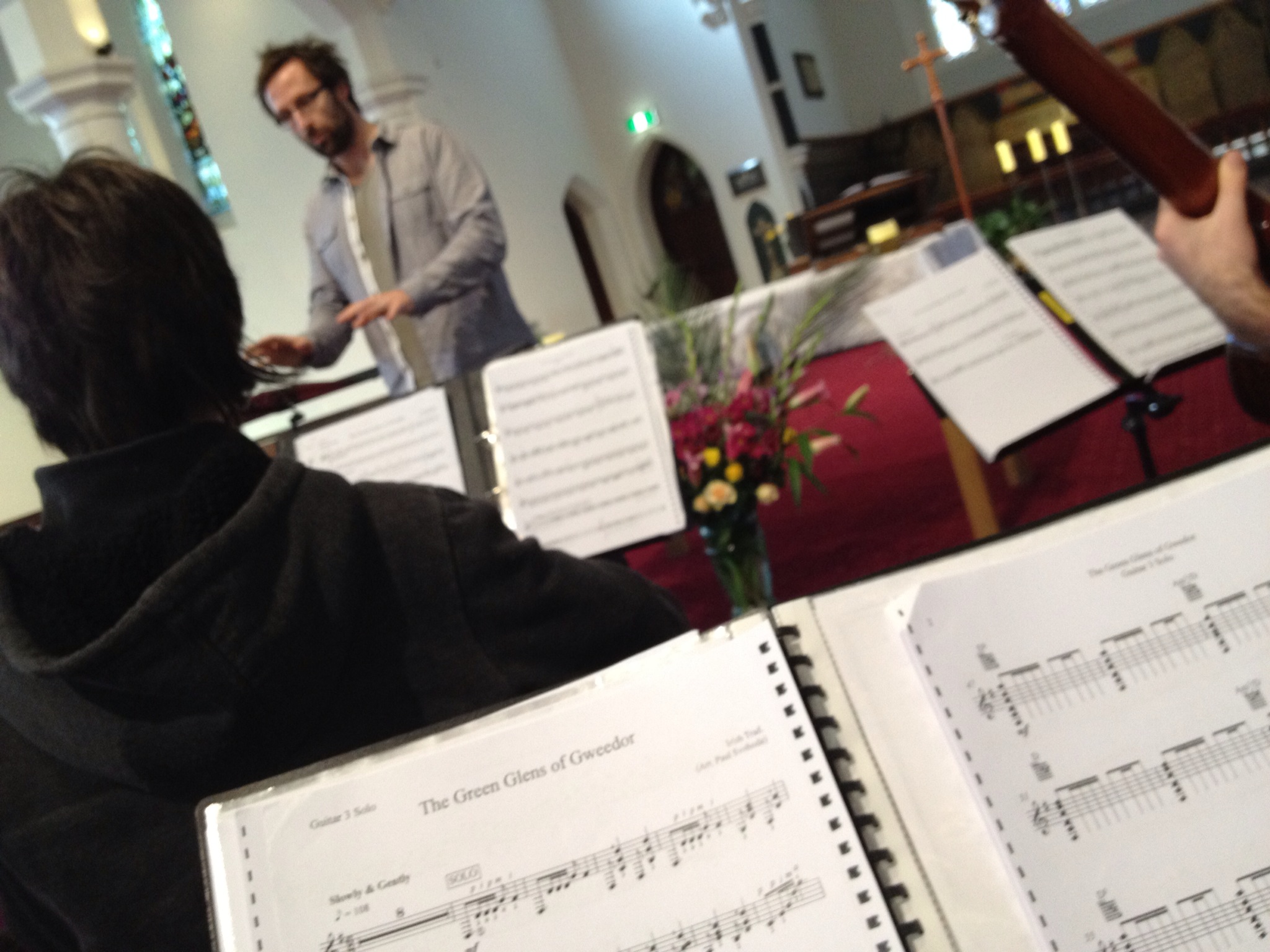
I was reminded this weekend by the first rehearsal of the season for the CGSV Classical Guitar Orchestra that by playing music with others is a wonderful experience. And playing with other musicians, be they at a similar level or a peg or two above or below you in their technical development can really present some excellent developmental opportunities.

CGSV GO

Playing with others, be it in a duo, trio, ensemble or orchestra, can deliver a umber of benefits to a guitarist. These include:

  • Encouraging you to listen to how others play and exposing you to different sounds and approaches.
  • Encouraging you to listen harder to your own sound.
  • And in combination of the first two dot points, encouraging you to listen to how your sound blends with others in terms of quality, tone colour, volume and dynamics
  • Encouraging you to listen and “feel” the music in synchronisation with others. That pause, that placement, the movement of a line. Of course the conductor helps in this regard, but there are somethings which are definitely “felt” and playing with others helps exercise this.
  • Getting you to look up from your score and watch someone else for cues, timing and pulse.
  • Picking up a pulse and taking it on (whilst watching the conductor of course) and exercising keeping a steady and even pulse, resisting the urge to push on or pull things back.
  • Pushing you a little beyond your comfort zone in playing stuff you wouldn’t otherwise play on your own
  • Improving your sight-reading and fretboard geography
  • Increasing your musical understanding and appreciation of working with others to achieve a musical outcome.
  • And, one of the most important of all, having a lot of fun!!

So, its well worth seeing if there’s an ensemble in your area (just classical guitar or mixed) or playing some duets or trios with another classical guitar (or other instrumentalist) friend. Playing classical guitar is good fun, but it’s even better when shared with others, in my opinion.