The Benefits of Playing In Ensemble for Classical Guitarists

The classical guitar tends to be rather a solo instrument with seemingly fewer opportunities for group playing than our orchestral or band-focussed buddies.  Well, perhaps, but only to a degree I think (depending on where you live I suppose). Where there are two or more guitarists, or yourself and another musician there lies an opportunity to play together, learn from and experience a new form of playing and of course have fun.

I was reminded this weekend by the first rehearsal of the season for the CGSV Classical Guitar Orchestra that by playing music with others is a wonderful experience. And playing with other musicians, be they at a similar level or a peg or two above or below you in their technical development can really present some excellent developmental opportunities.
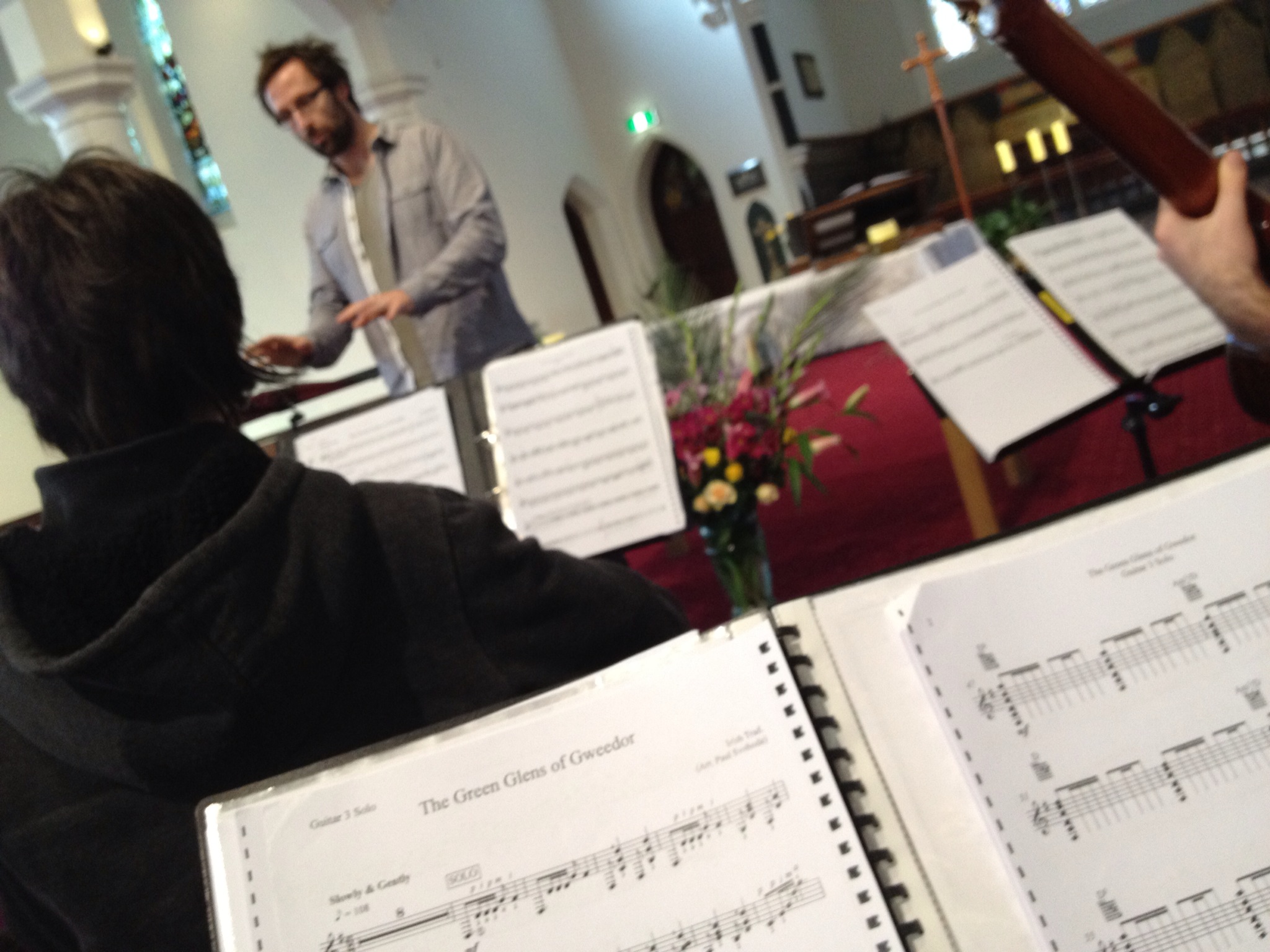
CGSV GO

Playing with others, be it in a duo, trio, ensemble or orchestra, can deliver a umber of benefits to a guitarist. These include:

  • Encouraging you to listen to how others play and exposing you to different sounds and approaches.
  • Encouraging you to listen harder to your own sound.
  • And in combination of the first two dot points, encouraging you to listen to how your sound blends with others in terms of quality, tone colour, volume and dynamics
  • Encouraging you to listen and “feel” the music in synchronisation with others. That pause, that placement, the movement of a line. Of course the conductor helps in this regard, but there are somethings which are definitely “felt” and playing with others helps exercise this.
  • Getting you to look up from your score and watch someone else for cues, timing and pulse.
  • Picking up a pulse and taking it on (whilst watching the conductor of course) and exercising keeping a steady and even pulse, resisting the urge to push on or pull things back.
  • Pushing you a little beyond your comfort zone in playing stuff you wouldn’t otherwise play on your own
  • Improving your sight-reading and fretboard geography
  • Increasing your musical understanding and appreciation of working with others to achieve a musical outcome.
  • And, one of the most important of all, having a lot of fun!!

So, its well worth seeing if there’s an ensemble in your area (just classical guitar or mixed) or playing some duets or trios with another classical guitar (or other instrumentalist) friend. Playing classical guitar is good fun, but it’s even better when shared with others, in my opinion.
Getting To Grips With Memorising Music

As wrote about a couple of posts ago, I’ve picked up a piece again recently that I had been “resting” (like resting a lovely piece of roast beef and letting the juices letting the juices flow prior to eating!).

In picking up this particular piece again I’ve decided to commit it to memory, and I’ve decided to really actively do this in a very methodical manner. And I’m doing so in a manner that’s somewhat of a tester of a slightly different technique for me. Sure I’ve gone about memorising things before, but in a way that’s left a few holes and potential for the stitching to come apart in live performance situations (which I’ve mostly managed to stitch together on the spot with material not necessarily belonging to that particular part of the music! Hah hah!).

This time, and after having read Daniel Goleman’s book Focus: The Hidden Driver of Excellence (which I posted about last time) I decided to really get to grips with really embedding this wonderful music into my brain and muscles.

Soundhole B&W

I’ve put my money where my mouth is and am literally breaking the music down into approximately 4 bar sections, or similar sized phrases if that makes sense musically to that particular section. In breaking things down in this way, I’m now re-examining what is going on across a number of elements and asking myself a number of questions.

I’m re-examining what is going on:

(a) Musically – do I know where the melody is? Where it has come from? Where it is going? Which voice is most important? What are the leading and landing notes in this particular phrase or section? Do I know what’s happening with the harmony? What are the chords?

(b) “Geographically” – do I know where my left hand is? Do I know where it has come from and where it’s going to? Do I know how it’s moving? Do I know what the fingering is? Do I know the fretboard locations I’m playing in? Are there alternatives that could work musically and technically/ In going through this exercise I’m also breaking down some of the bad habits that had started to form and becoming automatic, examining and questioning what I’m doing. By listening to what I’m playing I’m making transitions smoother in the process and tightening up things like trills. I’m essentially relearning small sections and “reprogramming” the automatic playing in a more informed manner.

(c) With my right hand – this is the hand that produces the sound (obviously!) and so I’m asking myself questions like which fingers am I playing melody lines with? Am I being efficient with my right hand fingering? Which fingers am I playing chords with and could I finger them differently? Do I definitely know which strings I’m playing with various chords? I’m also asking questions like do I like the sound quality produced? How does it sound? Is it consistent? What is the timbre I’m producing? What do I want to produce – a tasto, a ponticello, a good robust standard sound?

cropped-photo-17.jpg

So in asking these various questions of myself whilst going through this process of memorisation you can perhaps understand why I feel it’s important to break it down into very small portions! Once gone through this range of questions for a particular 4 bar, or similar, section I will repeat a number of times to begin embedding it. I will then stitch it into preceeding material that I’ve worked on in previous sessions.

Now, I’m not saying here you have to memorise. I’ve played both with and without music for a number of years. I do find though that you can really get to the heart of the music and almost free yourself to really get into the music having gone through the process of memorisation.

I’ll let you know how my little experiment goes!