
I’ve been doing a lot of travelling with work recently – Sydney this week, outback Queensland last week, Adelaide the week before that. Next week I’ll no doubt be somewhere different again! I used to stress a little about travel time and time away from the guitar, especially when aiming to prepare for a concert or something or other. I learnt though that that really wasn’t getting me anywhere (just giving myself a blooming headache!), so I decided to let that stress go as it wasn’t really serving me at all and thought what else can I be doing to “practice” whilst I’m travelling.
I’ve tried the travel guitar thing (and I’ve written a post about that some time ago), but I’ve found that travelling around even with that can be a bit of a struggle and that the airlines are insisting now that it is checked in.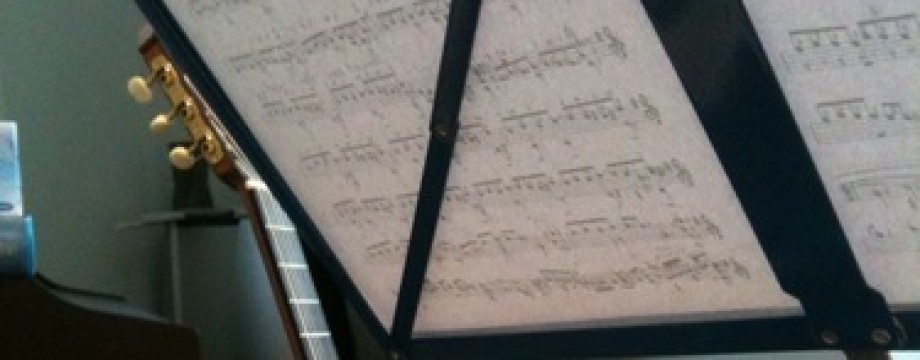
So, this is my latest “practice routine” whilst I’m away – take a piece or the piece I’m currently most focused on in my practice (La Maja de Goya for me at the moment, as regular readers will know) and apply the following exercises:
- Play the piece in my head through from the start (like an internal mp3) and with the aim of playing it through to the end. Whilst doing this in the early days (or even not so early days) of a piece there will be spots or even whole sections where the memory of the tune is a little fuzzy or where I can’t continue through. I make a note of this, as these are the spots where the aural memory is weakest – the spots I know least well musically. So the next time I come to sit down with the guitar these are spots to target before any others.
- Play the piece in my head, visualising my left hand movements – this is definitely way more patchy at the moment for me with La Maja de Goya than the aural memory. I probably get around 10 -12 bars in before things get a little fuzzy, but those opening bars I can clearly see the movement of my left hand. This tells me I most definitely know those opening bars and am feeling comfortable with them, and that next time with the guitar focussing on those in my practice is the least of my concerns. This is where some self-discipline comes in and resisting the urge to play through things from start to finish in practice time and being really focussed about what’s going to give the biggest bang for your practice buck in the time available.
- It’s interesting to note that I’ve never done any visualisation with right hand movements, possibly because I tend to play just really looking at the left hand (if I am looking at hands), so I’m not sure right hand visualisation would be as effective for me. I may, however, next time attempt exploring mentally some of the chord voicings with right hand visualation. Kind of like checking to make sure I’m playing the correct strings but without actually playing them!
- The next one is the most tricky (for me anyway) in the early days of getting to grips with a piece and that’s visualising the score. Again I can very easily see the opening few bars, but beyond that it starts to get pretty fuzzy. At this stage I can visualise the approximate shapes and so on in a reasonable amount of the score, but nothing concrete. So I make a note of whereabouts it gets fuzzy and next time I have the score in front of me I’ll know where I need to start building up and securing the aural, physical, analytical knowledge of the music.
- Not something I’m doing yet, but one to start trying next time I’m away from the guitar and that’s writing out the score on stave paper from memory – this will really show up how well that memory and knowledge of the piece is working! It will also help me in getting under the skin of the melodic and harmonic structure of the piece and getting to know it inside out.
This little routine, in whatever order and which ever steps, is something I can do in hotel rooms, aeroplanes, trains, airports, wherever. You could even do this on your daily commute to work on the train, tram or bus. Possibly not if you’re driving a car though!
Next time I’m travelling (which could well be next week again!) I think I may take a copy of the score with me (an electronic version on the iPad as that’s something I always have with me and I like to travel light) and add close study of that to the routine, plus using it as an aid to push a couple of extra bars with the memorisation of the dot points above. I’ll let you know how I go!
 Classical Guitar n Stuff