When Can I Say I Play Guitar?

This is one of those questions that pops up from time to time, folks wanting to know when it is that they can say they play the guitar, that they’re a guitarist, that they’re a musician or some other variant thereof.

The quick answer is really whenever you choose to! This is your journey and how you interpret is up to.John Price Guitar

I think there’s a bit more of an interesting discussion around the questions however.

From my point of view, I don’t think their can ever really be a single, definable point in time or point in a learning trajectory that you can say “I am a guitarist” or “I play the guitar”. I think the answer to the question “when can I say I play the guitar?” also depends a lot on your approach to learning and development in general.

I can’t really recall a point where I went from saying “I’m learning the guitar” to “I play the guitar”, although I think it would have happened relatively soon after starting lessons and getting a few little tunes under the fingers. For me, thinking about it, it was probably a point where I realised that I could play a handful of tunes reasonably well and that it was definitely something I wanted to continue persuing.

And that’s not to say that the two statements (“I’m learning the guitar” and “I play guitar”) are exclusive of one another – far from it! There is always more to learn, there are always things to improve on, there are always ways to develop, change and explore and always people you can learn from. To this day, although I probably wouldn’t actively say “I’m learning the guitar” if somebody asked me if I play an instrument, I most definitely hold the the attitude and approach of continual learning and development.

I’ve often said to students and peers that if you’re following the rewarding path of really studying classical guitar, striving towards mastery, the learning doesn’t necessarily get easier, but the pieces get do more challenging! It’s almost like you’re in a permanent state of learning (including not just a little brain strain at time!) and growth. A funny thing really because in spite of feeling this way (and I can vouch I did when I stated learning La Maja de Goya a few weeks back!), if you flick back to something you were playing say a year or so ago you may surprise yourself. If you’ve been playing for a few years and flick back to something you were playing say three, four, five years ago you may really surprise yourself – something you found a real challenge back then will probably be a walk in the park these days. So whilst you may feel like you’re permanently in a state of learning (which is a good thing in my opinion), your mastery is slowly creeping up on you……

So don’t forget to just stop and take stock from time to time and realise how far up the mountain you really have climbed. That may help you answer the question of “when can I say I play guitar?” for yourself.
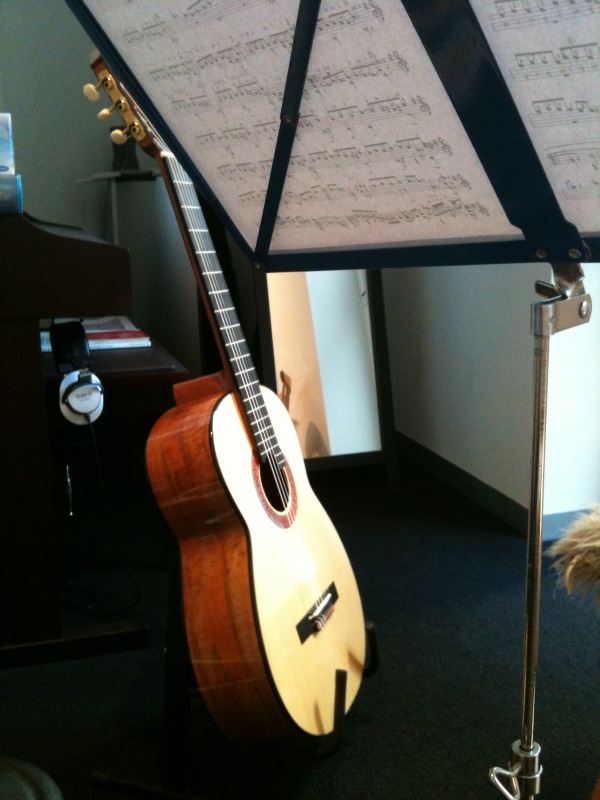
 

The Best Time To Practice Guitar

guitar_photo.jpgIt may sound daft, but I believe there are certain times of the day (for myself at least) that are waaaaaay better for practicing than others. For me a 30 minute or 60 minute period is not equal throughout the day. There are 30 minute or 60 minute “slots” that are worth significantly more in terms of output, results, progress and fruitfulness (call it what you will) than other times of the day.

The following outlines some of my own direct experiences with the best times to practice. I’m not saying that they’re going to be the same for all as we’re all wired differently and some of us are early birds and some night-owls and so on. Have a little read though, soak it in and perhaps use it as a guide to help you figure out the best times for your own practice.

1. 12 – 24 hours after a lesson

Whatever you’re working on with your teacher, and whatever level you’re at, in order to really maximise the time and effort spent in your lessons it’s really a must to sit down with the guitar and have a good practice session recapping things you were working on within 12 to 24 hours of a lesson.  And when I say “good” I’m not necessarily talking about a specific length of time here. I am talking about quality. Make sure you’re really focussed in on the things you were working on in the lesson, almost to the exclusion of everything else.

I’m not so sure about going home and practicing right away after a lesson. You’ve got to give your brain a bit of a break and a chance to assimilate the information you’ve just fed it.

Coming back to the instrument and honing straight in on the things you were working on within 24 hours of your lesson is key – your rested brain will have a reinforced message, you may find things occur more easily as a result of that rest. Importantly, not allowing more than 24 hours slip by between lesson and practice session means that you’ll have a greater chance of remembering things you and your teacher were working on!

If you can’t manage the other ideas here, please please please (please!) do this one!

2. At your peak flow time

For me this is first thing in the morning – for some reason the results yielded from a 45 minute practice session at 6am, seem to be worth at least 90 minutes worth of practice in the evening. That’s not to say that I manage to put in early morning practice most of the week – in fact, due to practical realities for me at the moment it means most of my practice sessions are in the evening at the moment. If, however, I have a particular bugbear with a certain technical element, or something very specific I want to really really focus on, then for me my peak flow time is the early morning.

If you’re a night-owl, however, you might want to try a later evening session and see how that works for you.

3. When you’re sufficiently fueled and rested

There is nothing worse for me than attempting to practice if I’m hungry or tired or both. I find if I’m hungry I really can’t concentrate properly and find myself getting far too easily and quickly frustrated with tricky technical issues – the “han-ger” (the hunger anger!). And if I’m tired then forget it! Sitting down to practice my head feels like it’s made of fluff and cotton wool is, I would say, even  less than a pointless exercise. I think the times I’ve attempted to sit down and practice when I’ve been quite tired (both physically and mentally) I’ve actually made aspects of my playing of a piece worse! If I’m tried I also find physical tension creeps in very easily and my movements are lacking in precision.

So moral of the story is make sure you’ve had a half-decent night’s sleep, or at least a rest, and are not in danger of becoming hungry before settling down to practice. Your brain and fingers will thank you for it, you will progress significantly faster and also (importantly) leave yourself less prone to injury due to unnecessary tension.