Classical Guitar Playing – Nails or Flesh?

I’ve been asked a couple of times recently my opinion on whether or not a classical guitarist should sport and play with a set of fingernails on the plucking hand, so I thought I’d produce a wee blog post on the subject for you today.

Well, my straightforward and simple answer to the question in today’s title is, for me, unequivocally nails. Yes, a classical guitarist, whether just starting out, developing, or well accomplished should really give serious consideration to growing a set of nails on the right hand (or left hand for left handed players).

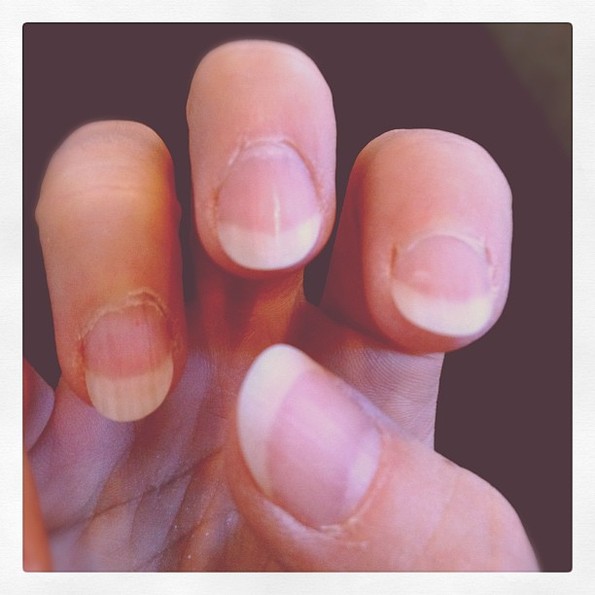
Why?Nails - filed and buffed, ready for action..

There are a significant number of benefits that can be derived from playing with fingernails that I feel, for myself at least, outweigh any annoyances in protecting and nurturing a prime set of playing nails.

For me these are, in no particular order:

  • You can produce some serious projection with nails that flesh alone cannot provide. The nail being a harder substance can dig into and through the string  for great projection.
  • It’s far easier to play at a greater speed whilst maintaining volume with nails than with flesh.
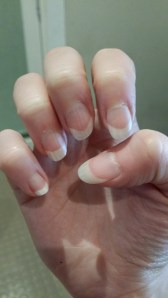
  • You can change the shape and length of your fngernails to experiment with different sounds and angles of attack (for example, the upper image to the right reflects the shape and length of may nails around 2 years ago. The lower image is my nails just yesterday – longer and a different angle of attack) . You just can’t do that with the flesh of your fingertips without moving your hand which may impact on playing.
  • Nails can help produce a lovely fat, juicy tone by rounding the playing edge and shining to a high gloss, glassy finish. It’s darn near impossible to get a such a smooth finish on your fingertips without damaging the skin!20140622_174923
  • Flesh playing can encourage the development of callouses on the plucking fingers (depending on the sensitivity of your skin) which can impact upon sound quality, not to mention become painful to play with. Fingernails avoids this by providing a surface that you can keep consistent by a little minor maintenance.
  • One of the greatest reasons for me  is the palette of colours offered by playing with nails – there are numerous ways that the nails, or nails plus fingertips, can be used to create a wonderfully, complex suite of tone colours.

Having said that….

Having said all of that, there is no such thing as “must do” – not really – in learning and playing guitar when it comes to nails versus flesh. And just because certain players do one thing, or tell you you’re mad if you don’t, that doesn’t necessarily mean it’s right for you. If you’re producing a sound that pleases you, that you can control and add variations of colour and dynamic into then however you’re producing it doesn’t really matter. Technique and “hardware” (be it instrument, nails, strings or whatever) should all be there at the service of the music.

It’s worth remember too that the current prevailing preference for concert guitarists to play with fingernails hasn’t necessarily always been so. The great Fernando Sor was a huge advocate of playing with flesh only. His compatriot Dionisio Aguado was firmly in the nails camp.

Experiment

If you’re a nails player blessed with relatively fast growing nails (or you’ve just taken a hit to one of your nails from an errant fly zipper or something) you could experiment with chopping them down (or chopping them off!) and getting a feel for pure flesh playing for a couple of weeks. It will probably feel strange if you’ve played with nails for a while so give it time.

Conversely, if you’re a flesh player try growing out your nails for a couple of weeks (or purchase some of the stick-on fake options), and experiment with some lengths and shapes for different sounds. Again, it will probably feel strange for a while, but give it a go. And if you don’t like it you can just chop them off again!

Learning Classical Guitar And The Mental Approach You Need For Success

I was reading an article on LinkedIn recently that resonated quite strongly with me and reflects my own thoughts around succeeding/ acquiring of skill (something that I’ve discussed with former students of mine too).

Those thoughts are that skills, and particularly skills such as learning and playing the classical guitar, are very much influenced by your mindset and approach to learning. I personally believe that old adage that you achieve pretty much anything if you set your mind to it.

Do You Have A Fixed Mindset or A Growth Mindset?

Folks with a “fixed mindset” (who might say things like “I am a musical person” or “I am not a musical person” or “I have always found this difficult and will continue to do so”), those that think that talent, brains, intelligence, natural gifts, call it what you will, are the answer to learning to play classical guitar (for example), can be their own worst enemy! Folks with a fixed mindset, thinking perhaps that they’re not good at something, like it’s something that’s set in stone, and the ones more likely to give in or give up at the first sign of challenge and difficulty.

Do you have this kind of mindset when learning a new piece? When developing an element of your technique? That’s preventing you from picking up the guitar even?

I seriously believe that a “growth’ mindset is vital when learning the guitar and progressing on the instrument (as it is with any instrument or skill). A growth mindset is acknowledging and appreciating that you’re probably not going to be that flash at something the first time you try it and possibly even for quite a while thereafter. A growth mindset acknowledges, however, that changes and improvements do occur over time – they may be large or they may be incremental, but undoubtedly they will occur. They don’t occur of their own accord though.

I’ve said this many times to past students, and I’ve said similar things many times previously on this blog too – the key to achieving mastery of the classical guitar (or at least getting a reasonable way into that journey) is focussed effort. Yes, talent can help, but it’s really the efforts that you put in, and the knowledge that you’ll improve, change and develop over time as a result of those efforts, that will set you on the path for success on the classical guitar.

For me when I first picked up the classical guitar I came to it with a background playing piano and clarinet, and having trained in classical dance for nearly 10 years. I was immersed in a musical world from a young age, so my “talent” (which was really just repetitive and consistent training and immersion over many years from a very young age – although that sounds rather brutal to put it in those terms!) carried me for a time. After the complete hiatus for a few years I had from playing in my late teens and early twenties, picking up the guitar again and wanting to really take things as far as I possibly could with the instrument, that’s where the “growth” attitude really came into its own.

I understood that a great deal of work lay ahead of me and came to enjoy that fact and the journey I was on. And I still do – my journey is still very much continuing. Part of this was also learning to be accepting of my technique at a given point and being in the moment, but knowing that I still needed to push and continue my hard work and focussed efforts to ensure the path ahead of me continued as I wanted. I was playing my path into view, if you like.

So do you have a growth mindset in your approach to learning classical guitar? Do you take technical challenges on? Do you ponder on how you can develop or overcome a particular challenge? Do you feel inspired listening to others? Do you appreciate that, given time and continued effort, you can play pretty much anything your heart desires?! I like to think it’s true 😉

And this is the article I was reading that sparked this blog post: http://www.linkedin.com/today/post/article/20140609121847-20017018-the-one-mental-approach-you-need-to-succeed