The Benefits of Playing In Ensemble for Classical Guitarists

The classical guitar tends to be rather a solo instrument with seemingly fewer opportunities for group playing than our orchestral or band-focussed buddies.  Well, perhaps, but only to a degree I think (depending on where you live I suppose). Where there are two or more guitarists, or yourself and another musician there lies an opportunity to play together, learn from and experience a new form of playing and of course have fun.

I was reminded this weekend by the first rehearsal of the season for the CGSV Classical Guitar Orchestra that by playing music with others is a wonderful experience. And playing with other musicians, be they at a similar level or a peg or two above or below you in their technical development can really present some excellent developmental opportunities.
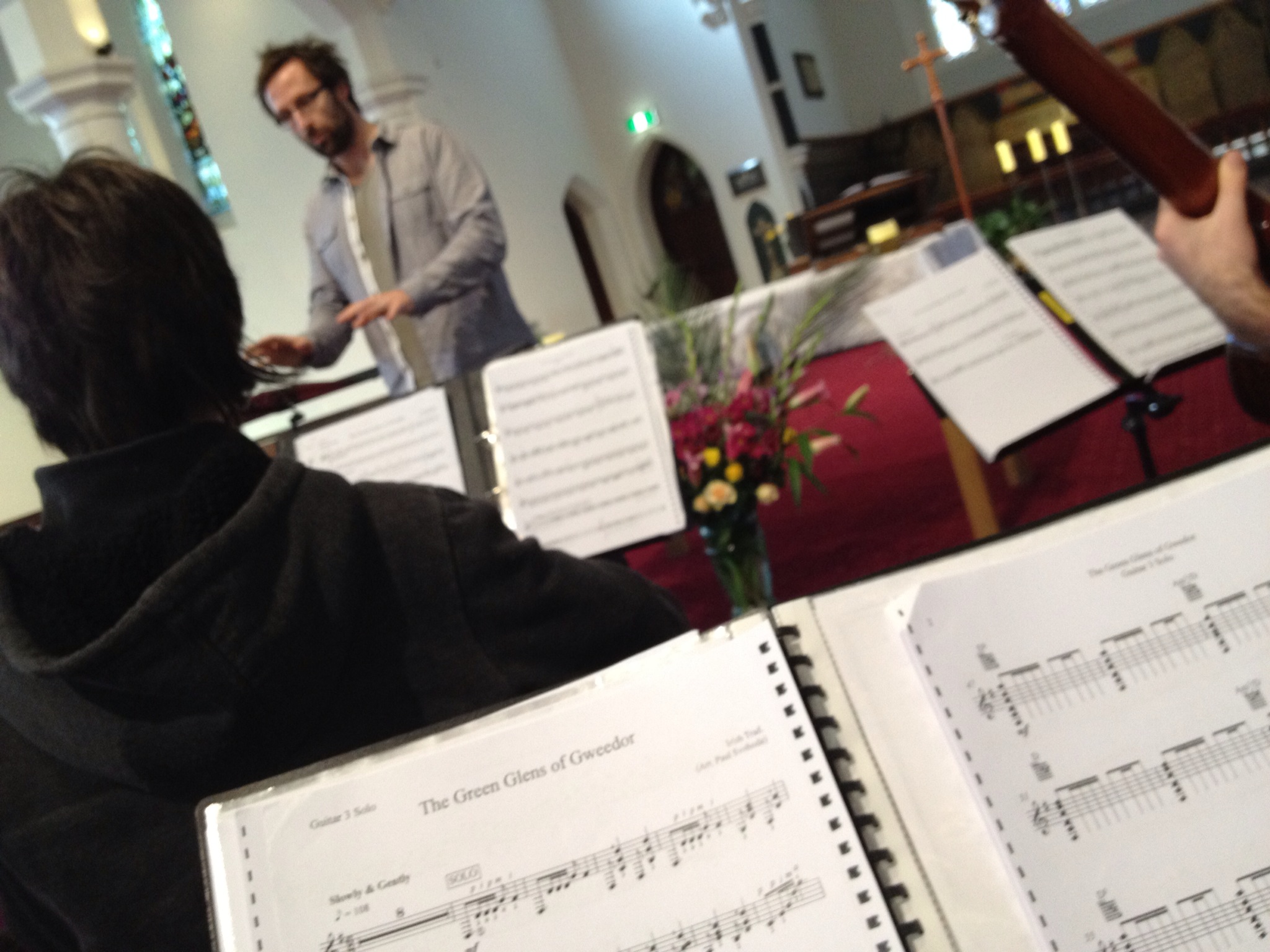
CGSV GO

Playing with others, be it in a duo, trio, ensemble or orchestra, can deliver a umber of benefits to a guitarist. These include:

  • Encouraging you to listen to how others play and exposing you to different sounds and approaches.
  • Encouraging you to listen harder to your own sound.
  • And in combination of the first two dot points, encouraging you to listen to how your sound blends with others in terms of quality, tone colour, volume and dynamics
  • Encouraging you to listen and “feel” the music in synchronisation with others. That pause, that placement, the movement of a line. Of course the conductor helps in this regard, but there are somethings which are definitely “felt” and playing with others helps exercise this.
  • Getting you to look up from your score and watch someone else for cues, timing and pulse.
  • Picking up a pulse and taking it on (whilst watching the conductor of course) and exercising keeping a steady and even pulse, resisting the urge to push on or pull things back.
  • Pushing you a little beyond your comfort zone in playing stuff you wouldn’t otherwise play on your own
  • Improving your sight-reading and fretboard geography
  • Increasing your musical understanding and appreciation of working with others to achieve a musical outcome.
  • And, one of the most important of all, having a lot of fun!!

So, its well worth seeing if there’s an ensemble in your area (just classical guitar or mixed) or playing some duets or trios with another classical guitar (or other instrumentalist) friend. Playing classical guitar is good fun, but it’s even better when shared with others, in my opinion.

Want To Play Spanish Classical Guitar? Listen To This….

In my practice recently I’ve picked up La Maja de Goya again recently, to start burnishing it up, committing it to a secure, multi-dimensional memory (i.e. left and right hand kinesthetic, theoretical, etc) and really understanding, listening to and feeling how I want to play this fantastic piece.

And part of this process now involves listening to not necessarily the piece as played by others, but other similar pieces. Similar works played in their original formats. With a lot of what we call standard guitar repertoire these days, from Spanish composers such as the likes of Albeniz, Granados, de Falla, was originally written for the piano rather than the guitar.

I find this activity gives some great musical insight and inspiration. Rather than just being limited by the guitar and its sounds, it brings a different, more purely musical perspective – how is the pianist, the musician, playing this line, this phrase? How are they treating these chords? You notice things when listening to other musicians, non-guitarists, playing things that perhaps you hadn’t noticed before.

Perhaps somethings have been missed or mistranslated even with transcriptions from piano to guitar that you like in the original and want to reinstate in your interpretation. Perhaps there are different techniques not outlined in the transcription you’re using that you wish to apply in creating a sound, or idea of a sound, that has been revealed to you in listening to the piano original. Perhaps you then create a mix of transcribed piece in front of you and elements you want to include or alter from that transcription.

Those of you who read the blog regularly will know that I travel around a fair bit. All this time sitting in airport lounges, aeroplanes and hotel rooms gives me plenty of time to listen to lots, and lots, and lots of music. Which is great from the point of view of exploring sources of inspiration. So today I thought I’d share with you some of the listening I’ve been doing recently in relation to developing my interpretation of La Maja (and, believe it or not, this doesn’t involve Julian Bream!).

I’d heard from many quarters (including a number of the folks I’ve interviewed on this blog) that the playing of Spanish pianist, Alicia Delarrocha (1923 – 2009), was most definitely worth checking out. On listening it’s easy to understand why – Delarrocha was clearly a musician of incredible ability and plays the music of Albeniz, Granados and the like to stunning effect.

As I said above, listening to some of this playing, for me, really brings a different dimension to the pieces I’ve listened to countless times played by many wonderful guitarists. There’s a real clarity to the lines, the feel, the textures and so on. Lots of food for musical thought with this wonderful woman.

But don’t just take my word for it…..

Here’s a clip of Ms Delarrocha playing Albeniz’s Granada from Suite Espagnola. The clip has a follow-along copy of the score too, which is interesting to see and hear left hand/ right hand treatments in the piano:

And Asturias (Leyenda) also, of course from Albeniz’s Suite Espagnola. It’s so interesting to hear these so very guitaristic pieces in their original setting:

I have absolutely fallen in love with her rendition of Granados’ Danzas Espangolas – I just love the Minueto and Oriental in particular. Here’s a clip of the full 12 from her 1954 Decca recording:

And to round this off here’s Granados’ La Maja de Goya for you: