The LMusA Diploma Journey – Update #1

I decided at the start of this month to begin a brand new journey on the guitar – one that isn’t necessarily going to be easy or short, but one that I will learn a lot from (and have an awesome bunch of repertoire to brandish), and that’s the journey towards taking my LMusA diploma.

If you missed it, or want to recap, here’s my first post about the start of the journey: The Start of A New Journey – The LMusA Diploma.

So, in the spirit of sharing (as I’m all about on this blog), I’d give you folks an update every couple of weeks as to how I’m progressing. And so here is the first official update for you!cropped-2010_09_25_guitars_003-scaled1000.jpg

What have I been up to this past fortnight?

Well, this past fortnight has really been about getting to grips with the first couple of pages (or the first major section really) of Granados’ La Maja de Goya. As I’ve said before this is an all-time favourite piece of mine so it has been quite exciting (in a total guitar geek kind of way) to be playing this piece – kind of like meeting your guitar hero, but in a non-tangible (and non-human, obviously), musical form.

I’m currently learning from and studying the Llobet transcription (the music was originally written as a song for piano and voice) which has some interesting editorial markings. At the end of this last couple of weeks I’m finding the first two pages (which I’ve been focussing on thus far) is covered in pencil marks! Whilst an editor or transcriber may be very skilled, talented and so on, I’m of the belief that there’s absolutely nothing wrong with me adding my own thoughts, fingerings and approaches into the mix – and I’m going to town so far on this one! I’m going all out with scratching out Pizz. markings, putting things up the octave, all with a desired musical outcome in mind. The desired outcome may change, and so may my pencil stratchings, as I really get to grips with the music, but for now I’m very happy to experiment and trust my own judgment.

Well, that and that of Julian Bream’s too. I’d be lying if I said I wasn’t strongly influenced by the English maestro in (a) playing the piece in the first place, and (b) his gorgeous approach to playing it. That said, there is one small elements that I’ve chosen to alter from Bream’s rendition, which is more in line with the line with the print score. This is an element that I felt on closer inspection and listening would allow greater clarity in the musical line and consistency with previous material. I’m sure there will be many more elements like this as I study the music more closely, listen to and develop my own thoughts on approach.

I’ve also started to think about what else from the syllabus repertoire list I’d like to play. A big, fat, multi-movement work is definitely on the cards and would really be expected (if it’s not already a specified requirement in the syllabus – I should check that just out of interest….). At the moment, I’m weighing up the prospect of Leo Brouwer’s El Decameron Negro (a three movement suite of around 15-17 minute I think) and Federico Mompou’s luscious Suite Compostelana (a six movement suite, written for Segovia in 1962, clocking in at around the 20 – 22 minute mark). I’m leaning towards the Mompou at the moment as it’s really quite beautiful. Very melodic, with an impressionistic kind of quality to it.

What’s on for the next fortnight?

Well, we’ve got the Easter public holidays coming up and ANZAC Day public holiday on 24th April, so lots of available practice time! Yay! If I can, I like to try and fit in a couple of focused one hour sessions on these days. And when I say focused I mean focused. Going into the practice session knowing exactly what it is I want to work on and doing just that. No phone. No computer. A “Do not disturb” sign hung on the door (not really, but people know that I’ve gone into my music room to work). No other distractions.

In my practice I’ll be consolidating my work on the opening section of La Maja de Goya and venturing further into the piece, gettings notes under the fingers, making any fundamental editorial changes and exploring fingerings.

I’ll also be checking out further some of the other listed repertoire pieces, listening to various recordings of pieces, whittling down my favourites and pieces that will make a good combination in the recital and checking out some more scores.
Performing In Front of Others & Overcoming Stage Fright – Part Two

The promise of performing in front of others is a promise of experiencing that butterflies in the tummy feeling. That nervous tension, a nervous energy, a teetering on the edge, sometimes almost regardless of the size of audience, the nature of the audience, the size of the space.
And I think this is a good thing. It demonstrates that you care about what you’re about to do and share with others. You care enough that you want to show yourself in the best light, you care enough that you want to do justice to the wonderful music you’re playing, you care enough thaGo With The Flowt you want your audience to enjoy themselves.
There is a fine line though to this degree of caring. Yes, a dedication to our craft is good, but not to the point where our “fight or flight” response completely takes over, demonising our mind and body and incapacitating us!
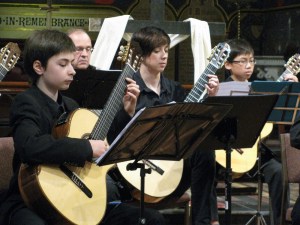
As I highlighted earlier in the week, a few of us from the CGSV Guitar Orchestra were sharing our thoughts about this subject following a successful performance. We were all of a similar mind in approach and in our experiences in dealing with stage fright, or performance anxiety or whatever you choose to call it. So I thought I’d summarise and share.
From my own point of view, leading up into the concert I was in no way concerned, or nervous. Really thoroughly prepared, could probably play a lot of the music without thinking about it. Until I got to about an hour or so from the performance and I noticed the heart rate picking up a little, a little light perspiration on the nose (yeah, I get that on the nose and not on the brow like most people!), that slight wobbly tummy feeling. Others in the group were also feeling this too.
Which is silly when thinking about it logically – what’s the worst that could happen to us in a church in Toorak playing Bach and Telemann for an audience of about 50 Bach-loving people with an average age of about 60? Let’s say our lives were really not in any imminent danger.
So in dealing with my own nerves, I gently reminded myself of this fact. I also reminded myself that I had done HEAPS of preparation and I could play the music quite beautifully in fact and to just trust myself, let go, play and enjoy the moment. I also told myself to just focus on playing with a beautiful tone and making beautiful shapes with the music.
And that calmed things down for me A LOT. The nervous energy was still there a little to a small degree, but I like a little bit of that – it heightens the senses, helps me get lost in the moment and focus on making a beautiful sound.
Trusting myself, letting go and enjoying the moment – this is the important bit in addressing stage fright for me. And my Guitar Orchestra colleagues were also expressing that they believe in the importance of letting go (even if it feels like going out on a ledge a little!), and have found themselves in other situations where they let the well-trained, almost subconscious process take over and quiet down the analytic part of the mind (which in these situations can just interfere with its incessant questions and doubts and get in the way!).
Trusting yourself and letting go can also be the bit most difficult to quantify and explain how to do also! I think it’s one of those things, however, that you just need to have a go at.
Commit to giving it a go in your next performance, accepting that it may not feel too different from normal (or previous situation normal), but is the first step, a leap of faith if you will, in a journey towards addressing your stage fright and performing at your best. And with most things the more you do it, the easier and the more embedded those neural pathways become.
Try these things for your next performance:
(i) Remind yourself of your environment and the situation– you’re playing music not completing life-altering brain surgery, you’re playing music for an audience of music lovers (most probably), you’re playing music for an audience of music lovers who are “on your side”. What’s the worst thing that could happen? Are you in danger? (If the answer to that is yes, you may want to look at the types of places you’re playing!)
(ii) Keep your breathing deep. When we get a little stressed our breathing becomes shallow which limits the oxygen flowing around the body and can cause undue tension in the neck and shoulder.  Breathe deeply and slowly. This keeps the oxygen flowing round your body and brain and helps to relax you.
(iii) Eat something small an hour so prior to the performance for energy – a light fuel stop will help keep your energy levels up.
(iv) Focus on your tone, phrasing and shaping perhaps (or some other larger focal point) rather than individual notes. This will start the process of helping you to trust that you really do know what you’re doing.
(v) Anticipate that you’re going to enjoy your performance! If you’re not sure, a bit of “fake it till you make it” can actually work and – hey presto! – you may just find that you are actually enjoying yourself!