Pre-Practice Preparation

With my travelling here, there and everywhere at the moment around the wide, brown land that is Australia (which I’m actually quite enjoying as it goes) I have to make my practice time with the guitar really count. That’s not to say that my practice prior to my super busy year-to-date wasn’t quality (one doesn’t get an AMusA diploma by slapdash practice!!).

It’s one of those interesting phenomena though that the more one is constrained by time, the more it sharpens ones focus. OK, well maybe it isn’t necessarily one those phenomena – just me! – but the limited time has made me re-examine what I’m doing, how I’m practicing and how I’m preparing for that practice. Especially given I have this goal of sitting for the LMusA diploma at some point in the not too distant future.

So, dear reader, I thought I’d write a wee post for you today on my approach to practice these days before I even pick up the guitar.

Prepare

A bit of preparation and planning can make for optimised execution in a number of areas, guitar practice included it seems! By thinking about and setting yourself up for a decent practice session you’re maximising the time you have available – be it 15 minutes or two hours – and hitting the ground running, so to speak, when you sit down and pick up the guitar.

What do I mean by prepare?

I’m not talking about writing out an action plan or anything like that (I’m trying to become more efficient here, not create more work). I mean thinking about what is that you want to achieve in this practice session.

Actively thinking about what you’re about to start doing and, importantly, WHY is the first step to making your practice time really count. If you have an idea in mind of what it is you want to achieve, then you’re more likely to achieve it! That’s not to say you’ll necessarily achieve your wee goal each time. but you stand a greater chance if you’re clear about what you want. You review what it is you’re doing and tweak the approach perhaps in preparing for your next practice session.

And it doesn’t have to be something big, and it doesn’t have to be a pile of things, that you’re thinking about and focussing on. In fact, I recommend just having in mind one or two things initially that you want to work on, correct, get your fingers around, and so on to get used to this and not overload yourself.

Think outcome rather than time

You’ll find yourself getting into the swing of it in no time. It’ll also help you apply a critical mindset (not judgmental mindset, please note) to how you’re practicing – you’ll find yourself asking questions like “is this what I want?”, “is this how I want it to sound?”, “what do I need to do differently to get the sound/ movement/ legato/ staccato that I’m after?”.

With this approach I’ve also found that time actually becomes less of an issue. I used to stress about “ooh, I’m not doing X amount of hours of practice per day or per week”, but I’ve noticed that being more prepared and more outcome-focused with my practice I’m much less concerned about the amount of time I’m spending (or not spending practicing). Consistency and regularity is still of vital importance, of course, by stepping back and thinking about what I’m doing I’m achieving what I want to achieve but without the self-inflicted pressure of being “bum in seat” for a billion hours a week.


So, are you making the most of your practice sessions? Do you know what you want to have achieved by the end of it? Are you just playing through or coasting through? Are you being perhaps just a little bit lazy?! (Don’t worry, we’ve all been there, and you’re a big fibber if you say otherwise!)

If you want to start getting some real “bang from your buck” during your practice time, pumping out the improvements and getting your fingers around that piece, then I highly recommend doing a bit of preparation
 

Classical Guitar Playing – Nails or Flesh?

I’ve been asked a couple of times recently my opinion on whether or not a classical guitarist should sport and play with a set of fingernails on the plucking hand, so I thought I’d produce a wee blog post on the subject for you today.

Well, my straightforward and simple answer to the question in today’s title is, for me, unequivocally nails. Yes, a classical guitarist, whether just starting out, developing, or well accomplished should really give serious consideration to growing a set of nails on the right hand (or left hand for left handed players).

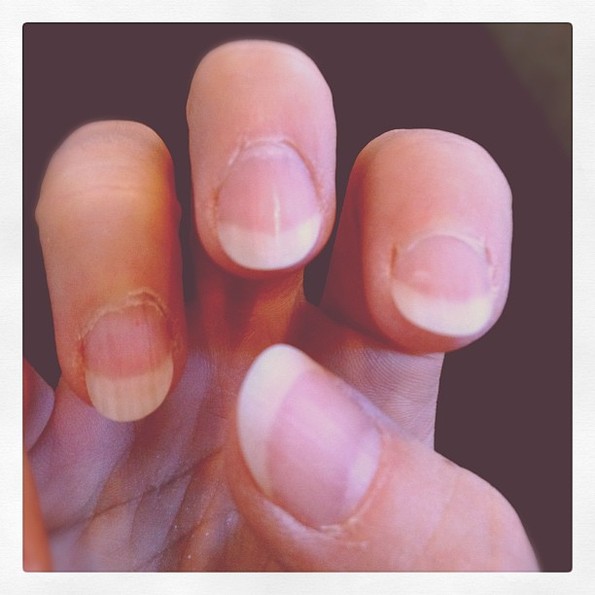
Why?Nails - filed and buffed, ready for action..

There are a significant number of benefits that can be derived from playing with fingernails that I feel, for myself at least, outweigh any annoyances in protecting and nurturing a prime set of playing nails.

For me these are, in no particular order:

  • You can produce some serious projection with nails that flesh alone cannot provide. The nail being a harder substance can dig into and through the string  for great projection.
  • It’s far easier to play at a greater speed whilst maintaining volume with nails than with flesh.
  • You can change the shape and length of your fngernails to experiment with different sounds and angles of attack (for example, the upper image to the right reflects the shape and length of may nails around 2 years ago. The lower image is my nails just yesterday – longer and a different angle of attack) . You just can’t do that with the flesh of your fingertips without moving your hand which may impact on playing.
  • Nails can help produce a lovely fat, juicy tone by rounding the playing edge and shining to a high gloss, glassy finish. It’s darn near impossible to get a such a smooth finish on your fingertips without damaging the skin!20140622_174923
  • Flesh playing can encourage the development of callouses on the plucking fingers (depending on the sensitivity of your skin) which can impact upon sound quality, not to mention become painful to play with. Fingernails avoids this by providing a surface that you can keep consistent by a little minor maintenance.
  • One of the greatest reasons for me  is the palette of colours offered by playing with nails – there are numerous ways that the nails, or nails plus fingertips, can be used to create a wonderfully, complex suite of tone colours.

Having said that….

Having said all of that, there is no such thing as “must do” – not really – in learning and playing guitar when it comes to nails versus flesh. And just because certain players do one thing, or tell you you’re mad if you don’t, that doesn’t necessarily mean it’s right for you. If you’re producing a sound that pleases you, that you can control and add variations of colour and dynamic into then however you’re producing it doesn’t really matter. Technique and “hardware” (be it instrument, nails, strings or whatever) should all be there at the service of the music.

It’s worth remember too that the current prevailing preference for concert guitarists to play with fingernails hasn’t necessarily always been so. The great Fernando Sor was a huge advocate of playing with flesh only. His compatriot Dionisio Aguado was firmly in the nails camp.

Experiment

If you’re a nails player blessed with relatively fast growing nails (or you’ve just taken a hit to one of your nails from an errant fly zipper or something) you could experiment with chopping them down (or chopping them off!) and getting a feel for pure flesh playing for a couple of weeks. It will probably feel strange if you’ve played with nails for a while so give it time.

Conversely, if you’re a flesh player try growing out your nails for a couple of weeks (or purchase some of the stick-on fake options), and experiment with some lengths and shapes for different sounds. Again, it will probably feel strange for a while, but give it a go. And if you don’t like it you can just chop them off again!