Well, dear readers, today we have a Q&A with a chap who’s becoming something of a regular on this blog (and deservedly so!). I invited the wonderful Rick Alexander (check out his most recent blog appearance here) to answer a few probing questions about the man behind the music…
Firstly tell us a little bit about yourself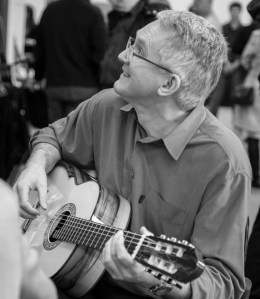
Firstly, thank you very much Nicole for the opportunity to do this Q&A.
I’m 54 and married. During the day I work in engineering – designing high sensitivity smoke detectors.
For about 20 years now as my hobby I’ve been passionately into playing and writing music for acoustic guitar. I’ve been writing both songs and instrumentals but for the last 6 years I’ve been working solidly on instrumentals for nylon string guitar. I’ve released three self-produced CDs since 1999 with my latest being Fine Light in September 2013. Two of the CDs are 100% instrumental with nylon-string guitar and one CD mostly guitar-vocal using steel string guitar.
I’ve played the steel string guitar since I was a teenager and back then I always liked playing songs which featured acoustic guitar such as Neil Young’s Needle And The Damage Done, or The Beatles: Here Comes the Sun or Blackbird. But with those songs alone I could never get enough acoustic guitar.
In my mid 30s I discovered how beautiful classical guitar could be at a guitar shop in Kuala Lumpur, Malaysia. (My wife, Babs, is from KL originally.) The owner of the shop was playing some intermediate level pieces on a Ramirez student model and really inspired me. I’d heard classical guitar before of course but usually very high level pieces, not beautiful solos at a level that I could imagine I could potentially play. So when I got back to Australia I started classical guitar lessons. A few months afterwards I also discovered how good the sound of handmade classical guitars can be. I was lucky to meet Phil Carson Crickmore in Melbourne and bought one of his guitars.
My favourite composers at that time were Andrew York, Federico Moreno Torroba and Eduardo Sainz de la Maza (although I didn’t play his music). My favourite guitar CD back then was Slava Grigoryan’s Spirit of Spain.
In my early 30s I’d started song writing on steel string guitar, mainly writing songs with lyrics. I also started writing my own instrumentals for nylon-string guitar in 1997. I recorded 18 of these and had a CD manufactured in 1999 which I called “Innocent Dreams”. I sold this CD mainly through galleries.
The album sounds great! What was the process for coming up with Fine Light?
Thank you! Fine Light has had a long birth. I worked on it through the 2000s in parallel with the guitar-vocal CD, These Places, which I released in 2006 with singer Adelaide Greenaway.
The first piece written for Fine Light was Missing You which I started in 2001. I’d been playing around with a tuning with the A string tuned down to G and found that my Carson Crickmore guitar had a really satisfying resonance if I played a G chord with open, 5th, 4th, 3rd and 2nd strings. The piece then built from there. Most of my writing is done that way. I improvise around until I find something I like, something which literally strikes a chord with me. And then I build on it, develop a number of sections and then fit them together. It’s like an enjoyable puzzle. I like to let happy accidents occur also. That usually leads to more variation.
So the pieces for Fine Light were written from 2001 through to 2013. The last, Silver, in July 2013. Most of the pieces were written in a few days. But for a couple I wrote one section first then added another section later. I did this for Missing You where I added the B section about a year later but the most extreme example was Destinations where I started it in around 2001 and added the B section last year to finish it.
I usually record new pieces at home as I’m developing them so I might end up with five to ten or so takes of the piece as it develops. I also usually notate them quickly using a short hand so I remember the main chord shapes I’m playing around. I then notate a lot of them fully using Tabledit or Sibelius.
What was the inspiration for the title of the album?
I was thinking of the clarity of light you get early on a sunny clear morning. Everything seems very defined. I.e. “Fine Light”. It’s my favourite time of day I’d say. I enjoy playing the guitar out in the back yard on mornings like that.
What is your favourite track on the album and why?
That’s a difficult question. My favourite to play would be Fine Light because it has a swing rhythm and I can let go and really get into it if I’m in the right mood. I’m also particularly happy with the sound quality of the guitar on the recording of Fine Light. The guitar was sounding good that day and there’s a medium tempo section 50 seconds or so in where the tone we captured is just what I was looking for. Apart from Fine Light my favourite to listen to might be Intersection. That’s a duet where I overdubbed myself. The overdub was improvised and I like it because the improvisation resulted in a lot of variation. I also like Once which is another improvised piece. I’ve never really tried to work out what I played in Intersection or Once and play them again. So that’s another reason for enjoying them. Maybe I hear them a bit as if played by someone else.
Can you tell us a bit about the recording process? Did you enjoy it? What were you favourite parts of the process? And the least favourite? How long did it take you all up?
I started recording the pieces myself. I bought two Neumann KM184 microphones in the early 2000s. I used these with a few different audio interfaces, most recently a Motu 128 Mk3 and also for two of the tracks, a Zoom H4. In 2009 I discovered a recording studio in Melbourne called Baker Street Studios which specialise in recording acoustic music. Baker Street Studios are owned by recording engineer Allan Neuendorf. Initially, I thought I would ask Allan to apply EQ and reverb to the raw tracks I’d recorded but I then tried a test recording in his studio and enjoyed it so much and liked the sound quality so much that I decided to re-record many of the tracks. I also recorded a few new tracks there.
I did enjoy the recording process. My favourite part of the process was playing the pieces at Baker Street and then hearing them back on the monitor speakers there. Getting absolutely the best sound recorded is very important to me. It’s very satisfying to hear the guitar coming back if it’s a good day for the guitar and I’m happy with how I’m playing.
The least favourite part would be the frustration in making a mistake late in a take! I find that the process can get a bit tense. Most tracks had some editing but it’s nice to keep the editing to a minimum so when I made a mistake late in a good take it was a bit annoying.
I recorded ten pieces at Baker Street and six pieces myself. Allan then processed and mastered all the pieces. The total time spent at Baker Street was about 40 hours. Looking back this sounds like a long time for 10 pieces! I usually tried to record two or so pieces in a three hour session. But several times I did retakes on other days. Also I recorded a few pieces I ended up not using on Fine Light. I spread the recording out from 2009 to 2013 as I wrote new pieces.
What “lessons learnt” did you take from the process of making the album? What would you do the same, and what would you do differently next time?
Things I’d do the same: I’d record at Baker Street Studios again. That was thoroughly enjoyable and I’m very happy with the resulting sound quality. Also I think I would continue to use some pieces I record at home if I think they’re well enough recorded.
The main thing I’d like to do differently would be to try to reduce the time frame a lot! One problem with the long time frame was that Allan changed his equipment a couple of times through the recording period. This resulted in some changes in sound.
I’d like to say I’d try to get all my pieces ready to record and then go in to do the recording in a relatively short space of time. For example, a few months of Saturday afternoons. However, having said that, I’m going to record some new tracks soon, simply because it’s very enjoyable to get them down. So I think that in the end the recording of the next CD will still be spread out a bit. Also, I actually think it’s useful to spread it out so there’s time to listen back and correct what you’ve been doing before too many studio hours have been spent.
Any plans for the next album?
I’m working on new music now and have six or seven pieces written. Some of these are duets which I’m planning to record with one Nicole Rogers in the near future! I’m honoured that you’ve agreed to record them with me.
What’s up next for you and in the next 12 months?
During the next year I want to promote Fine Light by playing to people regularly and also try to improve my playing and writing. I’m going to keep writing duets because I find these really enjoyable to write and play. With a duet I can separate finding a nice melody from what I can technically play.
What music (both to play and to listen to) excites you the most and why?
I like any guitar music which is both melodic and has interesting chord changes. In the 90s I was inspired a lot by Andrew York. His albums Perfect Sky and Denoument are melodic and very accessible. Recently my favourite guitar CD has been Ralph Towner’s Anthem which I discovered last year. It has a great sound and I really like his writing and fluid playing. Tommy Emmanuel’s Only album is very good. It also has good melodic playing. Andrew York’s 2006 Hauser Sessions album is good and the track By Candlelight is a stand out. The recording has a great clean mellow sound and, again, the track has a good melody. (Did I mention that I like melodic music!)
Also, I really enjoy listening to good original live acoustic music. At the recent Guitar Maker’s festival in Melbourne I spent an afternoon with my brother enjoying acoustic music, both songs and instrumentals. I hadn’t heard a single one of the pieces before and enjoyed them all. When I was young I only wanted to hear music I already knew but nowadays I find it equally enjoyable listening to good new music. Why? – I think it’s the pleasure in hearing good new melodies and chord changes for the first time. I’m always going for that tingle in the back of my neck.
Which guitarists do you find the most inspiring or exciting? And other musicians?
The guitarists who’ve most inspired my playing and writing would be Slava Grigoryan with Moreno Torroba’s Sonatina in A off Spirit of Spain. Andrew York with tracks like Andecy and Reflections off Perfect Sky. And recently Ralph Towner with his track Anthem. Also – Pat Metheny with his One Quiet Night Album.
In particular, two teachers Daniel Bodourian and Jarek Czechowicz have inspired me a lot. Daniel introduced me to composer Eduardo Sainz de la Maza’s music. In particular, the suite Platero y yo, which he played to me on one of Phil Carson Crickmore’s guitar the first time I met him. Jarek showed me great examples of what can be done with improvisation on solo guitar.
Other musicians: I still can’t go past The Beatles. In particular the early 60s stuff. I particularly like the early Lennon songs like “There’s a Place” or “I’ll be Back” for example. Lately my favourite Beatles music has been anything of Lennon’s up to about 1966.
My favourite recent albums are Tim Finn’s last few, particularly The Conversation and also Paul McCartney’s New. That one lasted 20 days on high rotation in my car CD player. He’s still got it.
And for a change the ACDC albums from the 70s are great for heavy blues. Their music has a great feel.
When you’re not practicing and playing what do you like to get up to?
I love getting together with friends and family. My perfect Saturday or Sunday is getting out and going for a walk and picnic in a park somewhere with my wife. As to hobbies I’m also into photography and I do some computer programming at home on my own project. Though this has fallen aside over the last couple of years while I finished off Fine Light!
What are your top tips for someone currently learning or thinking of learning the guitar and/ or writing their own material?
To the extent that I’m qualified to give tips – here goes! For someone starting out playing, I think that the key thing is to find guitar music at your level that you love hearing and then work on that with a good teacher. There’s good, interesting, modern music even at the earliest stages. For example, Andrew York’s Denouement album has some great early level pieces which are very musical and fit on the CD perfectly well with the more advanced pieces. Set yourself the challenge of playing pieces you love as well as you can, with a feel and sound that you make your own.
For someone thinking of writing their own material: If, like I did, you find it hard to start writing I would advise persevering and keep trying. You have to start somewhere and I’ve found that writing has gotten easier as I’ve gone along. It’s something that practice improves, just like playing. I think that the main point is that you don’t have to apply any rules. Just experiment, noodle around on the guitar and find what sounds good to you. For example, make up a 20-30 second chord progression that sounds good to you by starting with an arbitrary chord and then experiment to find a chord that sounds good after it. Then one after that, and so on. Record it on your phone and then play it back on a loop and experiment to see if you can find a melody line that sounds good over the top of it.
Sheet Music
I’d like to point readers to my website http://www.rickalexanderguitar.com/finelight.html where I’ve put free sheet music for two tracks from Fine Light. These are the title track and also Missing You. Fine Light starts off with straight timing for the introduction and then goes into an upbeat swing rhythm for the main part. Missing You has the alternate tuning I mentioned where the A string is tuned down to G.
I’ve also made the full track of Fine Light available for free download (make sure you head over there and pick it up folks!!– NR).
Thank you again Nicole!



 Classical Guitar n Stuff