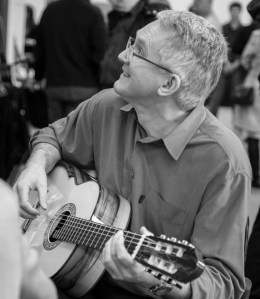
Interview with Canberran Classical Guitarist Extraordinare Minh Le Hoang – Part 1

I was very fortunate this weekend just gone, folks, to interview the supremely talented classical guitarist Minh Le Hoang ahead of his solo concert with the Melbourne Guitar Foundation on 9th May.

Minh Le Hoang

We had a great chat (he’s such a lovely, funny laid back chap), with Minh talking about the work he does in Vietnam, keeping familiar pieces fresh and his feeling on solo versus group performance.

As usual, I’m splitting the interview across a couple of posts for you.

Here you go……

Tell us a bit about yourself – who is Minh Le Hoang?

A bit about myself? What a question! You always feel funny talking about yourself. I’m based in Canberra, forever. We came from Vietnam in the early 1990s, as a teenager, and we settled here ever since., 24 years ago.

And I started classical then. When I was in Vietnam we played pop guitar, with steel strings, chords and whatever was around at the time. So I got into classical music here, and got into music through high school and went on and studied with Tim (Kain) for, you know, forever still! To this day!

So at the moment I’m just teaching at the Canberra School of Music (at Australian National University) and round a couple of private schools. That’s my main teaching job.

I perform solo, in duo with a flute player (a friend) and trekking with the boys (Minh is a member of guitar quartet, Guitar Trek). We’re preparing for a new CD in June.

I guess my solo activity has been going back to Vietnam quite often, to where I come from, once a year for the last 10 or 12 years. So I go back and do a few solo gigs and teach a bit there at the Conservatorium, share a few ideas, show them stuff we learn here. The kids over there don’t get the same sort of input so I try to contribute whatever I can.

Is there much interest in the classical guitar in Vietnam?

Yeah! It’s huge! Basically everybody plays guitar you know, whatever style. The classical guitarists there being years, and friends of mine organizing international festivals. This year they’re doing the second one. For Vietnam it’s quite a big step up.

Quite a lot of young, talented players but they don’t get the same sort of teaching you know. It’s all mostly self-taught. Even the teachers there, you know, are self-taught!

We’re very excited here in Melbourne that you’re playing a gig with the Melbourne Guitar Foundation on 9th May (check out further info here folks: http://www.melbourneguitarfoundation.com/events) – what are you going to play for us?

It’s a varied programme, a mixed bag of old and new repertoire I’ve been ticking over the last 6 months or so.

So there’s some Bach, the first lute suite in E minor BWV 996. A lot of Spanish music, there’s Asencio’s Colletici Intim. You’ve probably heard that one a lot, probably sick of it, everybody plays it you know!

There’s Rodrigo’s Invocation y Danza, some Torroba and a set of South American pieces – three Brazillian pieces and a waltz. So there’s a mixed programme of Latin, Spanish and Bach. The Bach is the odd one!

There’s no hardcore difficult listening in there. It’s all accessible I think.

Is there any rhyme or reason as to why you chose those particular pieces?

No, not really. There’s just some of my favourite pieces I like to play, some of those Spanish ones and it’s there under the fingers.

At the moment I’m doing a lot of teaching and not performing, on the road all the time, so you need to fall back on some of your more familiar pieces. But the Bach and the South American pieces are relatively new, yeah

How do you keep those very familiar pieces fresh?

That’s tricky. It all depends on how much time you have you know!

I guess the older you get, the more you teach, the more you form your own idea of how you interpret the music. I try to, you know, make the most out of what I know when I come back to pieces.

Some of it is still fresh because you’ve gone through different phrasings and articulations and you have better fingerings. In that way it’s still fresh even though you still have your memory of how the piece sounds.

Or you may change totally, looking in the score and saying “why did I do that?!” you know?

It’s only dangerous if you play the Chaconne when you’re 12 or 15 then you come back to it. It’s pretty dangerous, you have this notion of the piece formed as a 12 year old. Some people never tend to play it better. They took on this massive work when they were really young and they can’t change it.

We know you as a member of the enormously influential and world-renowned Guitar Trek, and you also play with a duo partner. Playing in a group or ensemble environment versus playing solo are quite different experiences – do you have any preference as to solo versus group playing?

Oh that’s a difficult question to answer. I actually enjoy doing both you know, solo and chamber music. But approaching the concerts for solo or chamber is so different.

When you’re playing solo you’re basically more exposed, you’re naked on stage really! It’s a lot more stressful doing solo, you know. Generally the repertoire’s harder, physically harder.

But there are also challenges in playing chamber as well. It’s playing with others. You’ve got to have a rhythm, you’ve got to prepare the parts as well as you can because you can play your part as well as anybody in your room on your own with a metronome. With the four or the two of you guys you tend to go off somewhere! It’s really hard.

But I do enjoy performing and touring with the guys, doing solo on a tour you can get a bit lonely. You get to hang out by yourself and do your own thing. With four guys it’s always much more fun! I enjoy both though I don’t have any preference.

—-

Head back this time next week folks for the second part of the interview!

Happy playing!

Top Classical Guitar Tips of the Year

Hi Folks, here are some of my favourite top tips featured on the blog from some of the fantastic classical guitarists I’ve been privileged to interview this year. Read on for some top tips from the likes of Xuefei Yang, Lily Afshar and Johannes Möller!

Andrew Blanch’s top tips for someone thinking of picking up the classical guitar:

I guess have fun is pretty important! Having a good teacher probably helps a lot too.

In fact, you know what, I think it can be really tough for adult learners. They’re often really good at what they do, wherever they work. That’s their thing that they’ve been going at – I teach people from the public service, something like that. They’re experts at something. And maybe the skills involved in music aren’t necessarily the same as the ones in whatever they’re doing. It can be hard learning from someone younger than you too. A lot of teachers are students and that sort of thing.

With regards to getting a teacher I think, as a classical guitarist, is assumed. I’d really think about what the teacher is saying. Really just have some trust, I would say. Allow yourself to trust this new concept, this new way of thinking and approaching a way they may be trying to get you to think. Just have trust and just give it a go, thinking in the way they’re teaching you. And don’t necessarily assume that the thought processes to do what you’re doing are going to music as well.

andrew-blanch-black-and-white

Check out the full interview here: https://classicalguitarnstuff.com/2014/11/20/interview-with-ascendant-aussie-classical-guitarist-andrew-blanch-part-2/

https://classicalguitarnstuff.com/2014/11/17/interview-with-ascendant-aussie-classical-guitarist-andrew-blanch/


Xuefei Yang’s Top Tips for somebody just starting out on the guitar:

For beginners – that’s a hard question! Hmmm….to be honest for beginners, I think it’s really important to have a good teacher. I really think so. I think that with the violin, the piano, the reason why they have so many great players is that they have a longer tradition of teaching and they have more perfect systems of teaching, that’s why they can produce so many good players. I think in way, I personally feel that the guitar teaching system is still developing, we don’t have such a tradition. As a beginner, it’s very important to have the right method, for your technique. It’s very important, for adults or children, it’s very important. I really think that a good teacher is very important for beginners.

But I do want to say something to more advanced students – I just feel that lots of guitarists, guitar students, or maybe amateurs, tend to focus on the guitar world. Maybe they play the guitar because simply they love the instrument, which is no problem at all, nothing wrong with that. But I just feel that they’re more fanatic about the instrument. I hope that they can put themselves in the sea of music. Myself I love guitar as an instrument, but I think of guitar just as a method, just as a medium, of music. It’s a media to express music and I like to think about music more than about the instrument. I think that  for more advance students, if they want to be a musician, to make a career, I think it’s quite important to put yourself in the sea of music and think more generally about music, rather than just guitar.

Since I moved to London I play concerto a lot, I play chamber music a lot, and this has helped meimmensely! Musically and technically too. Musically, you know, if you just play solo guitar, which is a beautiful instrument, there is a great limitation. But if you play chamber music, or you listen to an orchestra the music becomes richer, so much more possibility. If you’re soaked in that music and you’re forced to do more on your instrument, do more musically, that forces you to push your technique. It forces you to do the things that you want. So I really feel that the technique improves, in the more advanced stage, when you want to play more music.

The beautiful Xuefei Yang Photo credit: Neil Muir

Check out the three part interview here:

https://classicalguitarnstuff.com/2014/09/01/interview-with-classical-guitarist-xuefei-yang-part-1-of-3/

https://classicalguitarnstuff.com/2014/09/04/interview-with-classical-guitarist-xuefei-yang-part-2-of-3/

https://classicalguitarnstuff.com/2014/09/08/interview-with-classical-guitarist-xuefei-yang-part-3-of-3/


Rick Alexander’s top tips for someone currently learning or thinking of learning the guitar and/ or writing their own material?

To the extent that I’m qualified to give tips – here goes!   For someone starting out playing, I think that the key thing is to find guitar music at your level that you love hearing and then work on that with a good teacher.  There’s good, interesting, modern music even at the earliest stages. For example, Andrew York’s Denouement album has some great early level pieces which are very musical and fit on the CD perfectly well with the more advanced pieces. Set yourself the challenge of playing pieces you love as well as you can, with a feel and sound that you make your own.

For someone thinking of writing their own material:  If, like I did, you find it hard to start writing I would advise persevering and keep trying. You have to start somewhere and I’ve found that writing has gotten easier as I’ve gone along. It’s something that practice improves, just like playing. I think that the main point is that you don’t have to apply any rules. Just experiment, noodle around on the guitar and find what sounds good to you. For example, make up a 20-30 second chord progression that sounds good to you by starting with an arbitrary chord and then experiment to find a chord that sounds good after it. Then one after that, and so on.  Record it on your phone and then play it back on a loop and experiment to see if you can find a melody line that sounds good over the top of it.

For the full interview with Rick head here:  https://classicalguitarnstuff.com/2014/03/17/qa-with-rick-alexander/


Johannes Möller’s top tip for beginners on the classical guitar:

“The most important thing, the number one, is to practice every day. I think even it’s just 10 minutes it’s better than doing one hour just once a week. Because that creates a routine, you create space for it.

It’s also because it becomes discouraging sometimes, but if you do a little bit every day things develop along very well I think. Even if it’s just 10 minutes. Regularity!

And for those progressing a bit further, or slightly more advanced students, on the classical guitar:

“It’s important to practice the very basic technical aspects, the very simple things, like doing the perfect stroke, doing the perfect slur even if it’s just one. The very most basic things. Because whatever you can’t do on its own, really slowly, you’re not going to be able to do it fast. So that’s kind of the secret. If you can’t play it slowly, you’re not going to play it any better fast! We all know that!

Guitar is a very difficult instrument, and so you do need to practice the technique separately to just playing the pieces. You can destroy pieces by playing them in so technical a way. If your technique already is strong you’ll much quicker master a piece.”

For the full interview with Johannes head here: https://classicalguitarnstuff.com/2014/07/07/interview-with-classical-guitarist-johannes-moller/