An Interview with Australian Luthier Allan Bull

I’m so very pleased to present this article today. Allan is a well-respected member of the Australian guitar making community and was the maker of my very first high quality, truly hand-crafted instrument. He’s been so very helpful in answering my questions about the guitar over the last few years.
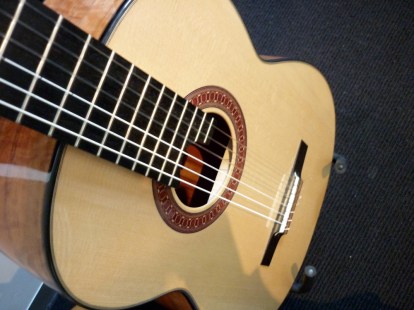
My beloved Allan Bull guitar
My own beloved Allan Bull guitar

Allan kindly agreed to take some time out of the workshop to provide us some insight into his style and approaches to making his marvellous instruments.

1) Why guitar and not any other instrument? In fact, do you build any other instruments?
I guess the simple answer is that the guitar is built mainly from wood.  It’s a wonderful intersection between two of my great loves – music and working with wood.  I build requintos and the occasional steel-string guitar but haven’t bothered with any of the guitar’s relations whether plucked or bowed.  Maybe a cello one day……..
2) How long have you been making guitars for and how did you get into it?
I built my first “serious” guitar over forty years ago but didn’t start building commercially until about ten years ago.  I built a couple of guitar-like instruments in my early teens but my interest really took off when I bought a Japanese Xenon nylon string guitar at about fifteen years of age.  This was soon followed by a Hagstrom classical and a Maton 12-string and I built my first guitar a couple of years later.
3) Who did you learn your craft from?
Like so many other luthiers my first detailed instruction was from Irving Sloane’s “Classical Guitar Construction”.  This is a wonderful book and was a great starting point for me.  My other early inspiration was from Frank Williams who was a guitar shop proprietor in Brisbane in the 1960’s.  Frank repaired guitars but I don’t think that he ever built a guitar from scratch.  Nonetheless he encouraged me and others to give it a go.
I have since learned something from every luthier to whom I’ve spoken and from each guitar I’ve played.  Every one teaches you something, even if sometimes it’s what not to do.
 4) What is your philosophy or vision in making your guitars?
My philosophy is fairly simple.  I try to build the most playable guitar that I can with as much tonal response and consistency across the range as I can engineer and with the fewest vices that I can achieve.  All guitars have vices/weaknesses.  It’s essentially a flawed instrument.  If the classical guitar wasn’t so charming players wouldn’t tolerate its shortcomings.
The sound is all-important but I believe that the guitar needs to be structurally sound and durable and aesthetically pleasing as an object.  I like to use Australian woods wherever possible, but never for the soundboard.
5) Who or what are your inspirations? What is that inspires you?
My ongoing inspiration comes from the players.  Otherwise I might just as well make timber craft or designer furniture.  If there weren’t players willing to support Australian luthiery, buy our guitars and make them sound good, I wouldn’t bother.

6) Which other guitar makers do you admire? Why?

I admire any luthier who develops a design, makes it work and builds guitars with integrity that stand on their own merits.  There are quite a number of Australian luthiers who seem to me to achieve this.  Most luthiers have their own sound signature and a particular guitar cannot appeal to every player.
If I were to single out one Australian luthier it would be Simon Marty.  To my ear his spruce guitars have a great balance across the range and a wonderful array of (in tune) partials.  There’s all the attack you could want with great sonority and sustain.  In the hands of the right player they sing in the trebles and growl in the bass and the mid range does exactly what’s asked of it.  Karin Schaupp and Anthony Garcia provide all the evidence of this that you could want.
I also admire the work of Jean-Noel Rohe, a French luthier, though I must admit that I have not heard his guitars “in the flesh”.
7) Australia seems to punch well above its weight in guitar making talent. Why do you think that is?
Australia tends to punch above its perceived weight in many areas so I don’t think that this is necessarily peculiar to luthiery.  I am sure that the fact that Smallman is an Australian helps the rest of the world to take notice of Australian guitars.  However, this would not be nearly as persuasive if Australian guitarists and teachers didn’t so wholeheartedly support Australian luthiers.  I don’t know of one Australian classical guitarist of any note who does not own and play at least one Australian concert guitar.  By-and-large, advanced players seem very willing to think of Australian hand-made guitars when they are ready to make the move to a concert guitar.  Obviously they wouldn’t do this if there weren’t very good Australian guitars on offer, but the importance of their support shouldn’t be underestimated.
I think it helps that we are prepared to experiment and do not feel so constrained by the dictates of tradition as our European counterparts.  And luthiers seem to be well over-represented in the Australian population.  I have not done the detailed numbers but would be surprised if we didn’t have two or three times the number of professional luthiers per capita of many European countries with a much longer tradition in the instrument.  There’s nothing like a bit of competition to improve performance.
8) What’s coming up on the horizon for Allan Bull guitars?
A lot more years of building and selling guitars, I hope, with incremental improvement.  I’m disappointed if each guitar is not better than the last in some way.  I will continue to experiment with new design elements.  I’m currently working on an asymmetrical grid soundboard bracing design with a view to improving evenness of response across the guitar’s range. I plan to do a much-needed update of my website next year with new sound clips, photography and information.  This was supposed to happen this year but I managed to find other, more interesting things to do such as building.

Classical Guitar Debut Album from Taylor Brown – Conference of the Stars

As you will most probably know, dear reader, I very much like to promote new talent. You’ll also probably know that I also like to promote talent that adds something new, rarely heard or something slightly different to the repertoire.

I am incredibly excited, therefore, to introduce to you US guitarist Taylor Brown, who has recently released his first classical guitar album. Oooooh……

Taylor Brown earned a degree in classical guitar performance from Vassar College under the tutelage of Terry Champlin, whilst simultaneously touring steadily with folk musician Kate Taylor (sister of James Taylor. Yes, the James Taylor).  Brown has performed here, there and everywhere from Carnegie Hall, New York City, to the Napa Valley’s French Laundry, to a 5-star boat on the Mediterranean.

Taylor has made other recordings in the recent past, mostly with a bluesy,folky pop kind of flavour. His new solo guitar début album however – Conference of the Stars – is a step away from that. It’s “a journey into the ancient stories of the night sky. In this live and fully analog recording, original compositions and improvisations weave their way through the long-lost Greek melodies of Haralampos Eckmeksoglou, from Sunset to Sunrise.”

Sounds pretty cool huh?

Conference of the Stars – so what do I reckon then?

This is clearly a work born of a love of music and melody. I wouldn’t describe it as high art in any way and I don’t believe that’s intention. And believe you me there’s nothing wrong with that whatsoever. What is important is that this music has a timeless clarity and pure essence to it; a devotion to beautiful melody and romantic sensibilities.

The album has a very romantic style about it, with a slightly folksy element, built on pretty, very singable melodies supported by unfussy harmonies.

I really don’t mean that to sound like a bad thing at all. It’s great in its simplicity – it’s lighthearted, joyous, melancholy, easy-going all in one, with each of the pieces very much song-like in approach.

I really like, in particular, Venus, with Greek and Spanish inflections and hints. Brown plays this track very musically and with a delicious tone. One can imagine sitting out front of a Greek taverna, the sun hanging just gone down, crickets chirping, the heat of the day simmering down….. And album opener Sunset is lovely too. As a kind of lullaby, it has a gentle simplicity to it.

Don’t take my word for it for any of this of course. I urge you to check it out for yourself and form your own opinions! Head over to Taylor’s website right now and check out some excerpts from the album for yourself: http://www.taylorbrownmusic.com/Conference-of-the-Stars

I want to know more!!

I thought you might ask that, so Taylor very kindly took the time to answer a few questions, telling us a bit more about his background and the process of coming up with the new album…. He has a few good tips for those learning the guitar too. Read on!

What’s your background with the guitar? How did you get started?

There was always an interest in the guitar. I began playing around with my Dad’s big old Gibson guitar as a toddler. It used to sit awkwardly on my lap, facing upwards, while I plucked and made up little songs. I mainly taught myself to play blues, folk, rock and some jazz until the age of 15 when I was amazed by an older schoolmates’ performance. When asked about his training he mentioned that he had studied classical guitar from a very young age. The next week I started classical guitar lessons! Classical guitar quickly became extremely important to me and I practiced hard in order to ‘catch up’ on lost time. Upon matriculating at Vassar College, it was clear that classical guitar performance would be my major. During college I worked as the sideman for folk singer Kate Taylor (sister of James Taylor). So I was learning in the classical realm as well as the folk / rock realm.

What was the process for coming up with Conference of the Stars?

About a year ago I was scheduled to do a 3 month gig playing aboard a cruise ship. However, I was ‘burnt out’ from gigging too much and about a month before the scheduled departure a feeling hit that I should instead find a space and focus on creating. So I rented a small studio and began going like a 9-5 job. Immediately, a collection of melodies by Greek composer Haralampos Eckmeksoglou flowed back into my hands. I had been playing them intermittently since college and always felt particularly connected with them. It seemed natural to use them in a larger work.

While toying with the overall structure and arrangements I began having melodic ideas of my own. Some started as transitions or ways to tie the pieces together, but then also became their own thing. The title and thematic element for Conference of the Stars came after I wrote one of the central pieces, ‘Man in the Moon’ (which returns later as ‘Woman in the Moon’). The night sky has always been fascinating and inspiring… And so the idea was basically a story of planets and constellations beginning with Sunset and ending with Sunrise. I don’t really have a clear memory of when I considered the work complete, but I practiced and performed it in all sorts of situations: blindfolded… for a group of 50 elderly nuns… on the rooftop… I think it always changes a little and comes out a bit differently.

What else are you working on at the moment?

I’m honestly trying very hard to follow through with Conference of the Stars before embarking on a new project. I think it’s often a problem for artists – once we finish a song or a painting we move on to creating a new one and the older ones can get lost. I spent so much time and gave so much of my soul to this album and I feel that the recording worked out really well too. So I’m focusing my energy mostly on getting it out there! Of course there are always songs in the works though…

What can we expect to see from Taylor Brown in the next year or so? 

I hope to be performing Conference of the Stars all over the world.

Is there any chance of us seeing Taylor Brown performing in the Land Down Under?

I certainly hope so : )

What are your top tips for someone currently learning or thinking of learning the guitar?

Practice! Even if you can’t play a lot every day, 15 or 20 minutes a day (consistently) will pay off. I think Bach is a great composer to start playing early on because his music works fast and slow… Even if you’re playing through the Cello Suite No. 1 Prelude quite slowly, it can still sound ‘musical’ and be enjoyable. Also – put away your smartphone so you can really focus!

What music (both to play and to listen to) excites you the most and why?

Live music is wonderful. I love going to the symphony and I also love a good street performance. My excitement about music really depends on the emotion it imparts and the pulse. As far as playing – classical guitar is by far the most challenging material I perform and so that challenge in itself is exciting. My connection with playing and singing blues/jazz and folk is always very strong, so when the audience is really listening that is wonderful too.

Which guitarists do you find the most inspiring or exciting? And other musicians?

There are so many wonderful guitarists out there! I’m often amazed and excited by performances or albums I hear – but I may not even know who is playing or may never hear it again. Some of the guitarists I have thoroughly listened to and learned from are Robert Johnson, Doc Watson, John Williams, Terry Champlin, Jimi Hendrix, Tao Ruspoli…

When you’re not practicing and playing, what do you get up to?

I definitely have a soft spot for cooking and drinking wine (and cheese). I’m also a pretty avid runner and I draw/paint.