Album Review: Premieres by Hilary Field

I have been fortunate yet again, dear readers, to have the enormous pleasure of listening to and reviewing for you a fantastic recording, this time by award-winning guitarist/composer Hilary Field.

This recording features world premiere music by contemporary composers that celebrates the natural lyrical, rhythmic and harmonic beauty of the classical guitar. It features contemporary pieces, some of which have been dedicated to Hilary, from Richard Charlton, Douglas Lora, Jorge Morel, Alberto Cumplido, Victor Kioulaphides, Nadia Borislova, Gerard Droza, Rick Sowash and Field herself.

In the recording’s creation, Hilary worked closely with each of the respective composers to expand the guitar literature  – a huge plus point for me and something I think that more classical guitarists should be venturing to do. So first “well done” on that Hilary, as far as I’m concerned!
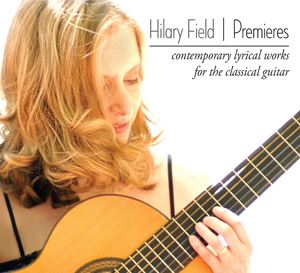
And for those of you not familiar with Hilary, she’s a Seattle, Washington based guitarist and composer and has garnered praise for her dynamic virtuosity, her sensitive musicianship, and for the emotional depth she brings to the heart of classical guitar music. Hilary is a past winner of the Northwest Young Artist Series Competition and was the first guitarist to win the Francis Walton Soloist Competition. She has held faculty positions as the head of the Guitar department at Seattle Pacific University and Pacific Lutheran University. She has released several award winning CDs, including her debut recording, “Music of Spain and Latin America,” which was an award winner for Classical Album of the Year by the National Association of Independent Record Distributors. Hilary was recently sponsored by the US Embassy to perform and tour in South America, and has been a featured performer in international guitar festivals such as Festival Entrecuerdas in Chile, Festival Internacional de Guitarra ICPNA in Perú, and Série Grands Concerts in Québec.

On first listening, aside from I’m struck by the quality of the playing, depth of musicality and great selection of newer pieces.

The Giga from Jorge Morel’s Suite for Olga could well be my favourite from the 19 individual tracks on the album – sprightly, fun and stunningly played. Controlled abandonment, if that makes sense?! I could hear that in lesser hands this could get out of control! Clear and precise lines, yet with a tangible sense of enjoyment in the playing and unwaveringly beautiful tone throughout. A really lovely closing piece to this great three piece suite from Jorge Morel.

Richard Charlton’s Lauro-inspired Vals by Moonlight from the Suite Latina  and Douglas Lora’s Northeastern Lullaby are also worth a mention, with the former creating somewhat of an earworm for me. I want to play it for myself now – there’s a real inspirational quality to Hilary’s playing that I’ve not experienced for a while with a recording.

And I can’t overlook the opportunity of course to mention Hilary’s own piece Donzella: Fantasia on a Sephardic Lullaby. A heavenly melancholy delight. And you can take a listen (and watch) for yourself right here…..


Donzella: Fantasia on a Sephardic Lullaby

Overall Premieres is a high quality recording – superb playing with beautiful depth of tone, excellent production and a great collection of contemporary classical guitar pieces (something we definitely need more of out there). A highly recommended recording, and quite possibly one of my favourites for the year. Very well done indeed.

Premieres is available now on iTunes, Google Play, Amazon and all good record stores. Do yourself a favour and buy your copy now!

And if you want to catch Hilary in person she’s currently scheduling a number of release concerts and will be featured in a number of upcoming international guitar festivals – check out her website for more details: www.hilaryfield.com

The Classical Guitar Practice Approach of A Very Busy Person!

To all of you, dear readers, who are playing or learning guitar, at whatever level, whilst studying, working, raising a family, looking after loved ones and/ or generally running around like the proverbial fly with a blue backside, I salute you!

Its not an easy thing to dedicate oneself to learning and developing a craft such as the classical guitar in amongst life. And I know that only too well first hand.

But just because something is challenging does not mean it is impossible. It means one has to think a little differently about what, where and how you practice, what that practice entails, calibrating expectations of yourself (and the self-induced pressure that that all too often entails), what outcomes you’re aiming to achiveve and of course a smattering of discipline and will.

Little Miss Busy - Penguin Books
Little Miss Busy – Penguin Books

I can go into the taking pressure off yourself, calibrating expectations, looking at what you want to achieve and so on in another post, but today I thought it may be helpful to share with you my general approach to practice now that my life has become rather busy. For newcomers here, I took on a fantastic and exciting role about 18 months ago which sees me with some longer hours and travel to some part of Australia on a very frequent basis.

I say “general” approach, as the specifics about what and how I practice can and will change depending on what I’m learning and if I have any concerts coming up. And the specifics will change for you too depending on your current level, what you’re aiming to achieve and so on. The general principles, however, apply just the same across the board,

My practice schedule, almost needless to say, has had to change to reflect my change in circumstance. And that’s fine – to be otherwise would be tantamount to stupidity and a sure fire way of giving myself a nervous breakdown. Which I’m sure you’ll agree is less than desirable!

So here are some of the key insights into the practice regime of a very busy person!

Consistency

One of the key principles that remains the bedrock of my practice regimen and something I’ve spoken about frequently on the blog is CONSISTENCY.

We are what we repeatedly do, or something like that, to partially quote Aristotle. In practical application that means practicing or at the very least playing the guitar (and there’s an important difference I’ll come on to) more days of the week than not. Even if that means just 15 minutes with the guitar because I’m tired and my brain is practically hanging out of my left ear. Something is most definitely better than nothing, especially when there is the potential for a very busy period to be a number of days or longer.

Focus and Purpose

When I do sit down with the guitar at the moment, its typically for one 40 minute session per day,  5 to 6 days per week. And when I do sit down to practice I do so with a very specific purpose in mind.

In recent weeks, for example, I’ve been learning the Fugue from Bach’s Prelude, Fugue and Allegro BWV 998. Not a small work, and not an uncomplicated work (on the LMusA list in fact for when I get back on track with that).  I have been breaking this up into small bite sized chunks, tackling just 8 bars in a 30 – 40 minute sitting, really teasing out knits and tangles, tricky technical challenges, examining and rearranging fingerings, understanding what’s going on in the music, its direction and how I want it to sound. I might spend then 5 or 10 minutes slotting it back into context in the broader section or movement but keep the practice session focussed very much on that 8 bar section, knowing prior to starting that it’s that 8 bar section I want to work on and what I want to have achieved by the end of my session.

I’ll also either start or finish my practice session with a major scale and relative minor with full combination of right hand fingerings. I’ll make my way through the whole range of diatonic scales over a number of days and then go back to beginning.

Breathing Space

Focus and purpose goes out of the window though if I am feeling very tired with poor concentration ability. There’s no point in torturing myself! I have to be very tired though, and in this case I’ll still pick up the guitar and play through either a piece, part of a piece or a few scales just to keep the fingers moving.

I definitely don’t do this for more than one day, but giving myself permission one or two days a week to have some less involved practice time and just playing for the heck of it is as important as it is relaxing. Which is key when one is very busy!