
I had the pleasure of a fabulous conversation last week with Duncan Gardiner (whose recording with his mimi duo project I’ve previously featured on the blog) talking about his educational music project Fiddlesticks and their 30+ date tour here in Melbourne this month.
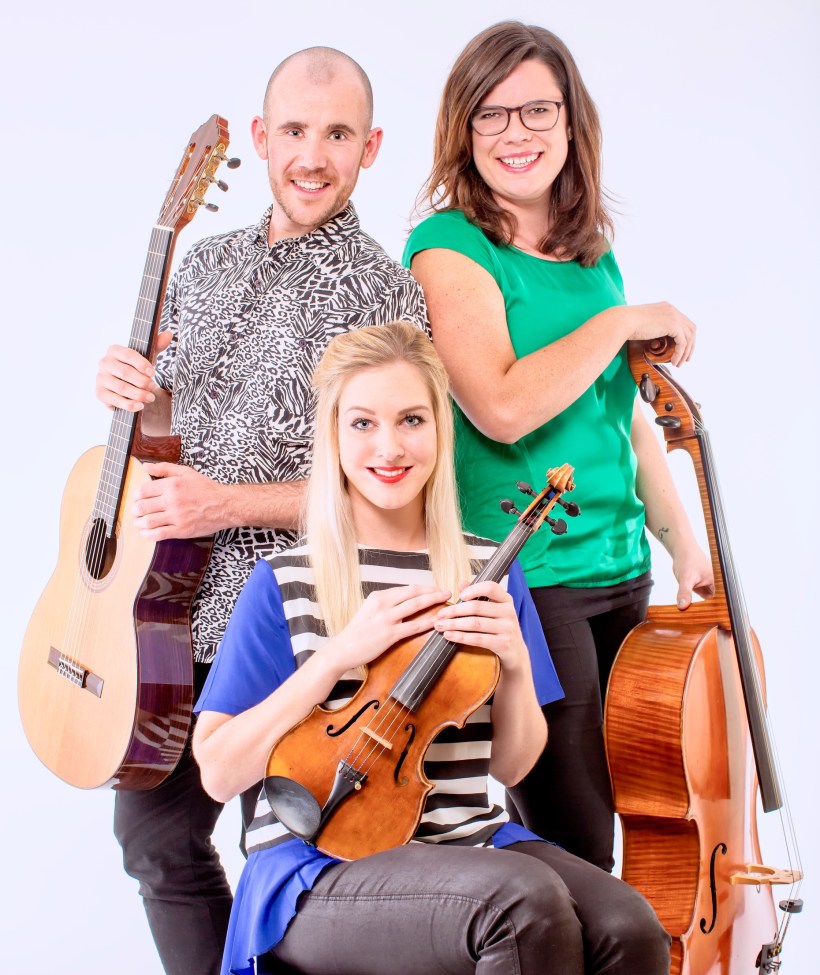
Fiddlesticks features Duncan Gardiner (guitar), Rachael Aquilina (violin) and Anna Sarcich (cello). Each of the members of Fiddlesticks are established soloists, chamber musicians, orchestral players and composers/arrangers having each performed with the Western Australian Symphony Orchestra and the West Australian Opera. Fresh from a glittering concert tour of Hong Kong for Premiere Performances of Hong Kong, 2016 has seen the trio perform across the most remote areas of the North West’s Pilbara and Kimberley regions as well as up-coming concerts across Melbourne and regional Victoria.
Fiddlesticks have given concerts in virtually every Western Australian town performing between 50-100 In Schools concerts for Musica Viva in Schools each year. Individually, they have toured internationally to countries such as the U.S., Japan, Scotland, England, Italy, France, Spain and Croatia.
Each of the members have recorded extensively, in particular Duncan, who has released 4 critically acclaimed studio albums. They are all graduates of the Western Australian Academy of Music and the University of Western Australia.
Read on for part one of my interview with Duncan…..
Tell us a bit about yourself – who is Duncan Gardiner?
I’m a freelance musician, I play guitar, classical guitar that’s what I do as a performer, but I play all sorts of instruments as well and I compose music. So that’s actually really where my true passion lies is in writing music. I find it’s the least stressful thing you can do. Obviously there’s nothing stressful about sitting in the comfort of your own home writing music.
I do perform a lot and I teach, I teach about 4 days a week. I’ve got about 40 students, and I love just immersing myself in all aspects. I do enjoy performing professionally, but as I said I do sometimes just enjoy playing recorder in community groups and things like that. I just really love music. I do do all sorts.
I wouldn’t consider myself to be one of those solo recital guitarists. I prefer chamber music, making music with other people. Still can be great, very serious music making but just not the whole pressure of performing solo. It can be very lonely – I’ve done that obviously studying.
So obviously you like performing in that group chamber music setting – that’s an excellent segue into talking about your trio Fiddlesticks. How did the three of you come together?
Musica Viva actually approached us, who were a group of musicians who had been involved in stuff in the past. It was the cellist who was approached, and they basically said “hey we’d like you to form a group, doing school concerts”.
One of the women who worked at Musica Viva was a classical guitarist. She said, you know, the classical guitar is one of the most popular instruments in schools in Australia, particularly in Perth, and we don’t have a single classical guitarist on the books. She said I know this guy called Duncan, maybe you guys could form a trio or something.
So we still had to audition and basically we formed with the sole purpose of doing concerts in schools. And then obviously the repertoire was chosen around that. We had a brief and that was to do on hour educational concerts in schools, for kids aged between Kindy and Year 8.
So it was combining two passions of mine, actually all three really – performing, composing (because I write music for it) and also education.
I think we’ve given probably this year alone probably 40 or more concerts, and of course in Melbourne we’ll be giving about 35 or something. So it’s a large number each year. Normally it’s in Western Australia, but of course this year we’ve toured across Hong Kong as well, and now interstate.
So Fiddlesticks are coming to Melbourne doing 35 different schools?
Yes, that’s right. We’ll be in metro city Melbourne for the first two weeks, and then the last week we’ll going and doing something in country schools. But even with the metro schools I think some of them are out 50 or 60km out of the city.
The three of you are coming to Melbourne on the back of some recent performances in Hong Kong and WA, what can these lucky kids look forward to?
Well, they’re going to get all sorts. What we do is weave story-telling into the show and we get the kids to use their imaginations. So we play pieces like In the Hall of the Mountain King and so we play the piece of music and we ask the kids how has the composer told the story with the music. So how did the music make it sound like the little boy was creeping, how did he make it sound like trolls were then chasing him,.
We play a piece by Khachaturian call Sabre Dance and so I have this plastic sword and we build the story of a heated battle between two female warriors. Because it looks as if the violinist and the cellist have swords. So we talk about that.
And there’s a tango in the middle. Ooh, what else is there? Some of my music, a Scottish-inspired piece. The kids learn all about Loch Ness and imagine the story of Duncan going up through the moors and the stuff around Loch Ness. It kind of opens up the kids imaginations, but directly through music.
It always has a very educational purpose – this is called accelaerando, or this is called rubarto, or arco or pizzicato, this kind of stuff.
We play the pieces of music from start to finish, we perform each item, and at the start we say “this is Rachel, can anyone say what instrument she plays?” Then the kinds answer and we say “let’s listen to Rachel play the melody on her violin”.
And we introduce the cello and we say “Anna can play the melody on her cello too”, and they can hear the difference between the cello and violin playing the same thing. We then play the bass line, and ask them what they noticed about the bass line – it’s low, or it’s deep or whatever.
Then I do this thing, a guitar demo, where I demonstrate strumming and pizzicato on the guitar and percussion. And then I get them to determine the quality of the strumming – it’s energetic, whereas pizzicato is quieter and muted. I get them to say the word muted eventually.
I play the Libra Sonatina by Dyens. At the end it has some crazy stuff, like tapping and strumming, and strumming the strings at the head of guitar, and I finish with that. So they get up close and personal with the instruments.
Then at the end of the show we actually get them to sing a song that I wrote. We sing the whole thing together, and they have these fruity maracas that they shake. It’s really really fun.
Check out some of the fab music that the lucky students of Melbourne can look forward to this month with Duncan’s composition Brandy Snap:

 Classical Guitar n Stuff